-AR Verbs (Ej: Hablar)
| Yo | hablaba |
| Tú | hablabas |
| Él/Ella/Ud. | hablaba |
| Nosotros | hablábamos |
| Vosotros | hablabais |
| Ellos/Uds. | hablaban |
The Spanish Imperfect Tense is used to describe past habits, ongoing actions, repeated events, background information, and situations without a clear beginning or end.
Use the Imperfect to talk about what things were like or what used to happen, not completed actions. If an action has no specific ending or is part of the background of a story, the Imperfect is usually the correct choice.
| Yo | hablaba |
| Tú | hablabas |
| Él/Ella/Ud. | hablaba |
| Nosotros | hablábamos |
| Vosotros | hablabais |
| Ellos/Uds. | hablaban |
| Yo | comía / vivía |
| Tú | comías / vivías |
| Él/Ella/Ud. | comía / vivía |
| Nosotros | comíamos / vivíamos |
| Vosotros | comíais / vivíais |
| Ellos/Uds. | comían / vivían |
| Pronoun | Ser | Ir | Ver |
|---|---|---|---|
| Yo | era | iba | veía |
| Tú | eras | ibas | veías |
| Él/Ella/Ud. | era | iba | veía |
| Nosotros/as | éramos | íbamos | veíamos |
| Vosotros/as | erais | ibais | veíais |
| Ellos/Ellas/Uds. | eran | iban | veían |
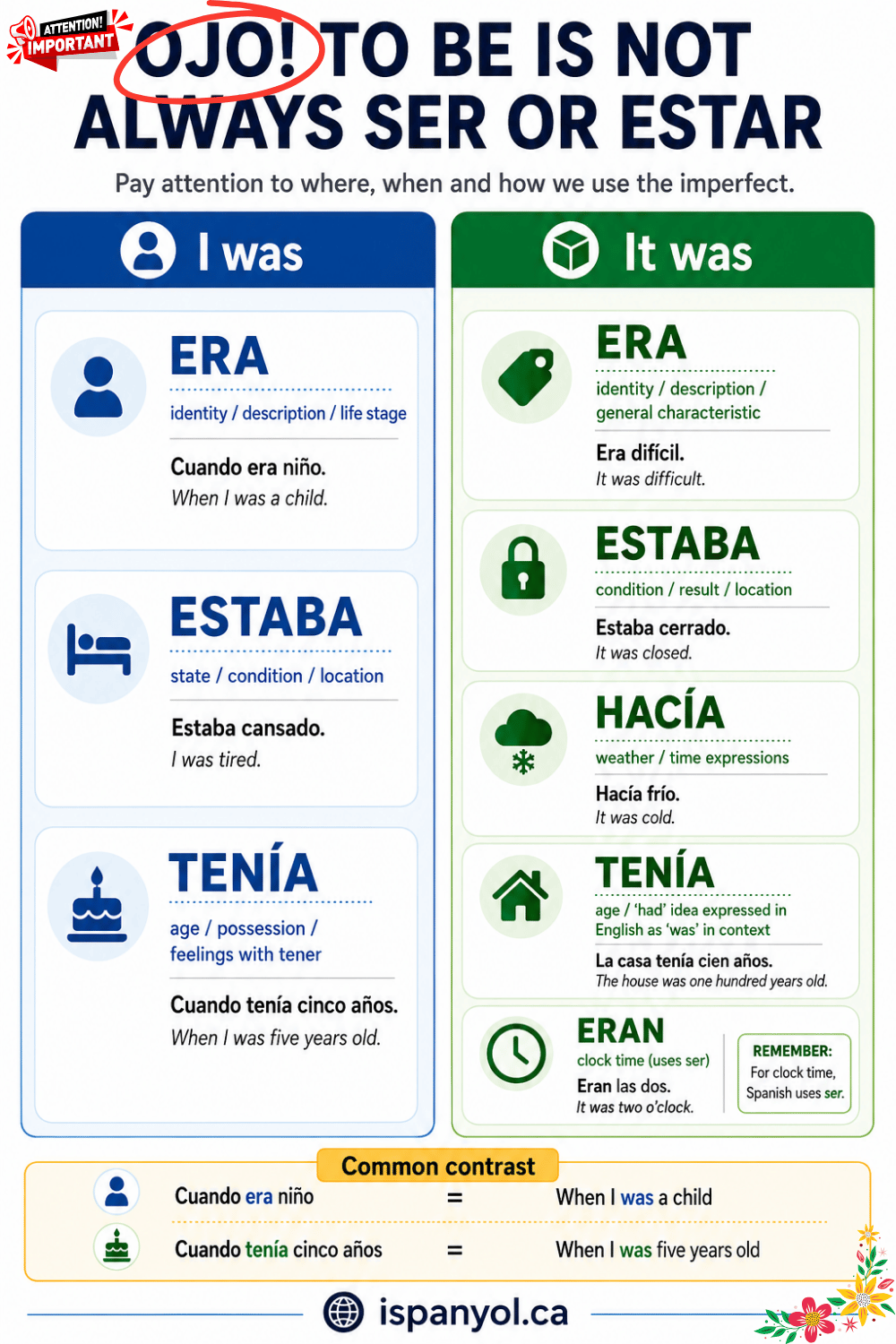
In English, I was and it was can look simple. In Spanish, the correct imperfect form depends on the meaning: era, estaba, tenía, or hacía. Clock time is another important case: Eran las dos means It was two o’clock.
Cuando era niño, vivía en Madrid.
When I was a child, I lived in Madrid.
Cuando tenía cinco años, vivía con mis abuelos.
When I was five years old, I lived with my grandparents.
Estaba cansado.
I was tired.
Hacía frío.
It was cold.
Actions that happened regularly in the past.
Actions that were in progress or interrupted by another.
Background info: people, places, weather, feelings.
English “was” can require different Spanish verbs depending on the idea.
The new practice activity is designed to help you switch between the present and the imperfect according to context, instead of practicing the imperfect in isolation.
Use it after this guide to practice forms such as tengo / tenía, es / era, está / estaba and other high-frequency contrasts in complete sentences.
Start the Present + Imperfect Fill-in QuizUso: Contexto, hábito, descripción sin fin claro.
"Siempre comíamos juntos."
(We always ate together.)
Uso: Acción puntual, específica y terminada.
"Ayer comimos juntos."
(Yesterday we ate together.)