Diminutivos y Aumentativos
Adding Flavor to Your Spanish
Diminutives and augmentatives are extremely common in everyday Spanish. They allow speakers to express size, affection, familiarity, intensity, admiration, criticism, or even irony.
Spanish Suffixes at a Glance
Diminutive · -ito / -cito
Smaller, softer, affectionate, friendly or less intense.
Augmentative · -ón / -azo / -ote
Bigger, stronger, impressive, exaggerated or sometimes critical.
Related intensity · -ísimo
Adds a very high degree: buenísimo, riquísimo, rapidísimo.
The suffix gives you a clue; context gives you the final meaning.
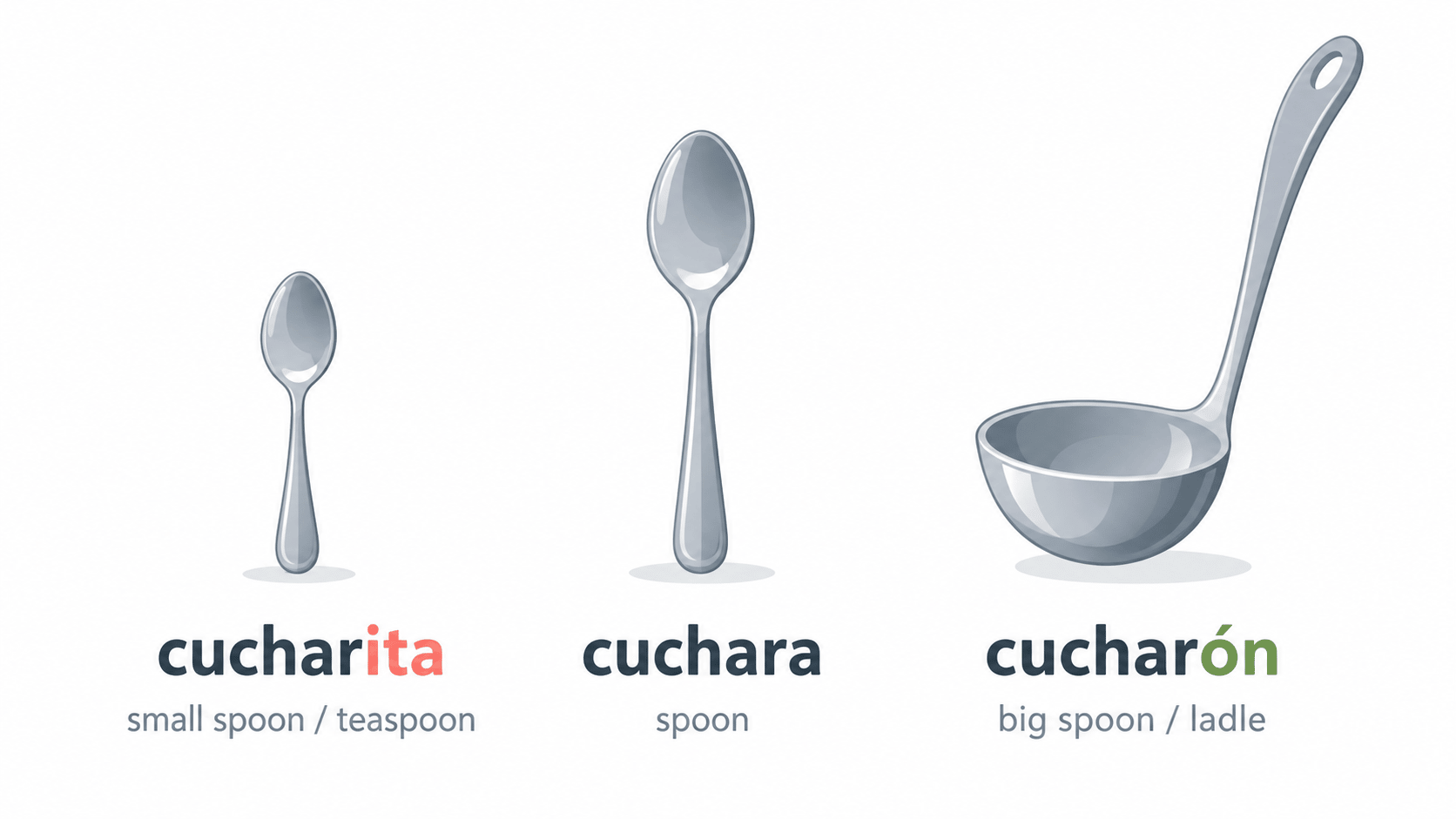
1. Spanish Diminutives: -ito, -cito, -illo
A diminutive is formed by adding a suffix to a word. While it can imply small size, it is frequently used to express affection, friendliness, politeness, approximation, or a softening of meaning.
Common Suffixes
Common Uses
1. Small Size
mesa → mesita (small table)
"Tengo una mesita en mi habitación."
2. Affection
abuelo → abuelito (grandpa)
"Mi abuelita vive en Madrid."
3. Politeness
momento → momentito
"¿Puedes esperar un momentito?"
4. Friendly Tone
café → cafecito
"Vamos a tomar un cafecito."
5. Approximation
cinco minutos → cinco minutitos
"Llegaré en cinco minutitos."
6. Immediacy
ahora → ahorita (right now)
"Lo hago ahorita mismo."
Common Formation Patterns (Not Universal Rules)
Ends in -o or -a
Add -ito / -ita
gato → gatito
casa → casita
Ends in -e
Add -cito / -cita
coche → cochecito
noche → nochecita
Ends in Consonant
Often -ito or -cito
papel → papelito
flor → florcita
Ends in -n or -r
Add -cito / -cita
joven → jovencito
mujer → mujercita
Diminutives in Real Spanish
Words such as poquito, despacito and suavecito show why diminutives are not limited to physical size. They can soften an idea, add nuance or make an expression feel more conversational.
Diminutives in Music: poco → poquito → poquitito
Songs make the change in tone easy to hear. Notice how Spanish can extend a diminutive for even more nuance or emphasis.
Un Poco Loco · Coco
Estoy un poco loco.
Un poquitito loco.
a little
a little bit
a tiny little bit
José José · La Nave del Olvido
Espera un poco, un poquito más.
Wait a little, just a little bit more.
Here poquito softens and intensifies the idea of “a little” rather than describing a physically small object.
2. Spanish Augmentatives: -ón, -azo, -ote
An augmentative is a word formed with a suffix that usually expresses large size, strength, intensity, admiration, or criticism.
Common Suffixes
1. Large Size
casa → casona (large house)
libro → librote (big book)
2. Admiration & Criticism
hombre → hombrazo (great man)
problema → problemón (big problem)
"Tiene un cochazo nuevo."
3. The Suffix "-azo"
-azo has more than one common job; it does not simply mean “big.”
💡 When the Suffix Becomes a New Word
Sometimes a derived form becomes an established vocabulary item. At that point, its modern meaning may no longer be predictable from the suffix alone.
mesa
table
mesita
nightstand
mosca
fly
mosquito
mosquito
señora
woman / mrs.
señorita
young lady / miss
camisa
shirt
camiseta
t-shirt
silla
chair
sillón
armchair
ahora
now
ahorita
right now / in a minute
Diminutive vs Augmentative: Side-by-Side
| Base Word | Diminutive | Augmentative |
|---|---|---|
| casa (house) | casita small house | casona big house |
| perro (dog) | perrito little dog | perrazo great/big dog |
| libro (book) | librito small book | librote large book |
| coche (car) | cochecito small car | cochazo impressive car |
| problema (problem) | problemita small problem | problemón big problem |
Related Pattern: Spanish Superlatives (-ísimo, el más...)
Superlatives are a separate grammatical category, but they belong in the big picture because Spanish also uses suffixes such as -ísimo to intensify meaning.
For the full comparison system — más que, menos que, el más, el menos and irregular forms — see the Spanish Superlatives deep dive →
Absolute Superlatives
Expresses an extreme degree without comparison. Use Adjective + -ísimo/a.
• grande → grandísimo
• rápido → rapidísimo
• importante → importantísimo
• rico → riquísimo (Spelling change c→qu)
• largo → larguísimo (Spelling change g→gu)
"La comida está riquísima." (The food is delicious)
Irregular Superlatives
Some adjectives have entirely special forms that you must memorize.
• bueno → óptimo
• malo → pésimo
• grande → máximo
• pequeño → mínimo
"Fue una decisión pésima." (It was a terrible decision)
Relative Superlatives
Compares one thing with a group.
el/la/los/las + más/menos + adj
Juan es el más alto de la clase.
Juan is the tallest in the class.
Es el menos interesante.
It is the least interesting.
Everyday Spanish: Tone, Context & Regional Variation
Diminutives
Augmentatives
Superlatives
Tone changes meaning
¡Qué problemita! can be genuinely soft — or ironic, depending on tone. Suffixes often express the speaker's attitude, not just size.
Ahorita depends on context
ahorita can mean “right now,” “in a moment,” or refer to a short time around now depending on country and context.
- •
Diminutives do not always mean "small." They often express affection, friendliness, or politeness.
- •
Augmentatives do not always mean "big." They may express admiration, intensity, criticism, or exaggeration.
- •
The suffix -ísimo is one of the most common ways to say "very" or "extremely" in Spanish.
- •
Diminutives are common across the Spanish-speaking world, but their frequency, preferred forms and nuances vary by region.
Mini Practice: Read the Suffix Before You Translate
When you meet a new Spanish word, first look at the ending. Very often, the suffix tells you the speaker's attitude before the dictionary meaning does.
un problemita
a small problem / a little issue
un problemón
a big problem / a serious issue
rapidísimo
extremely fast / very quick
un golazo
an amazing goal
un ratito
a little while
poquito a poco
little by little
Explore Related Topics
Continue with adjective formation, powerful verbs, and focused quizzes.