Direct Object
lo · la · los · las
Veo la película → La veo.
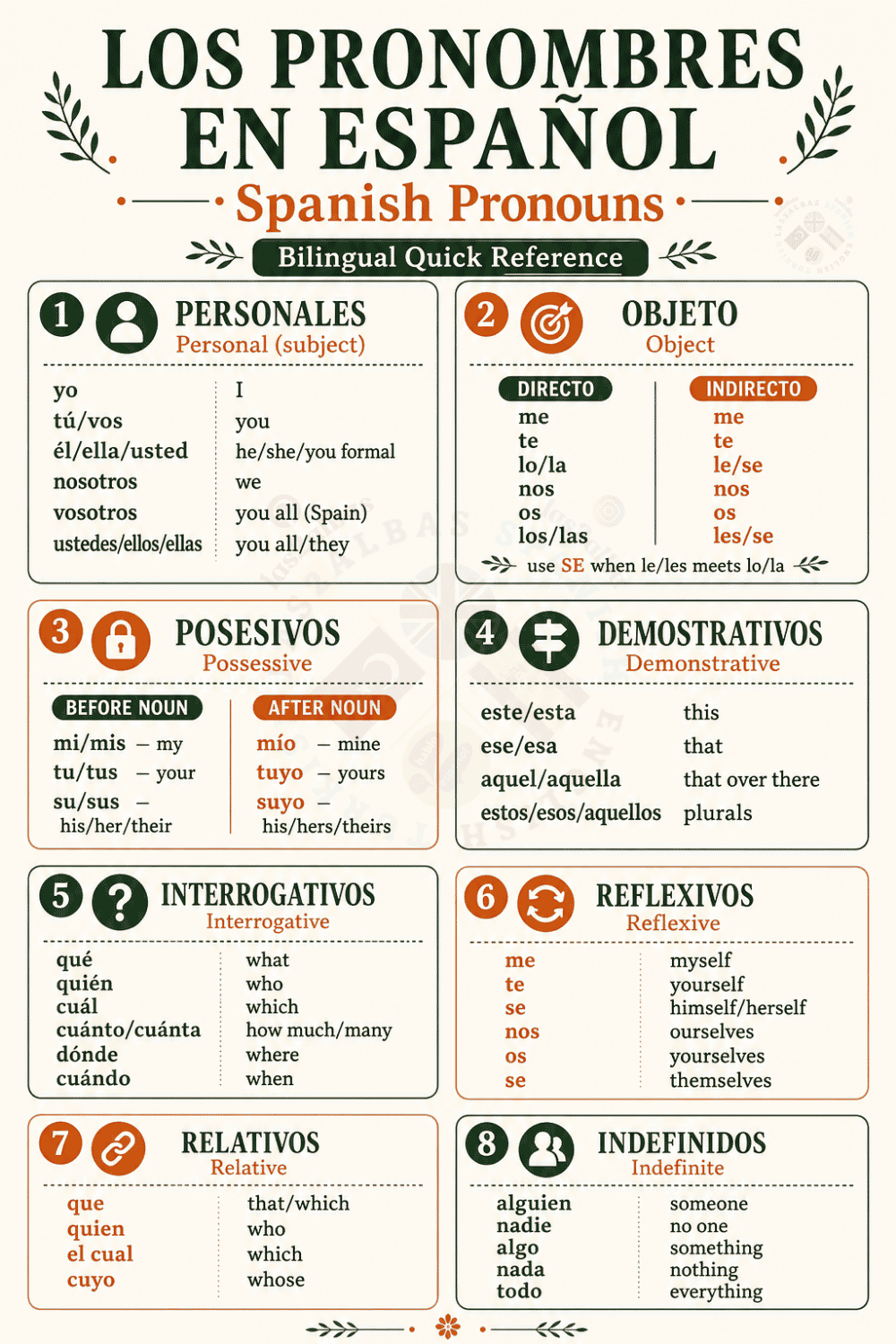
Practise lo, la, los, las, le, les, se and pronoun placement through natural Spanish sentences.
Direct Object
lo · la · los · las
Veo la película → La veo.
Indirect Object
me · te · le · nos · os · les
Doy el libro a Ana → Le doy el libro.
Two Pronouns
le / les → se + lo/la/los/las
Le doy el libro → Se lo doy. (I give it to him/her.)
Pronouns normally come before a conjugated verb. They may attach to an infinitive, gerund or affirmative command: lo veo · quiero verlo · estoy viéndolo · míralo. In negative commands, pronouns come before the verb: no lo mires. An attached pronoun may require a written accent: explícamelo.
Choose 12 or 24 questions from a reviewed question bank. Each question has an English translation, a hint and a grammar explanation.
Choose your round
The world leaderboard is for 12-question rounds only. Longer rounds are practice-only.
Question 1 of 12
A2–B1 · Object Pronouns
Quiz Result
Correct
0 / 12
Score
0%
This was a 24-question practice round. World ranking is reserved for 12-question rounds.
Loading scores…