Pronunciation
h is silent.
hola sounds like “ola.”
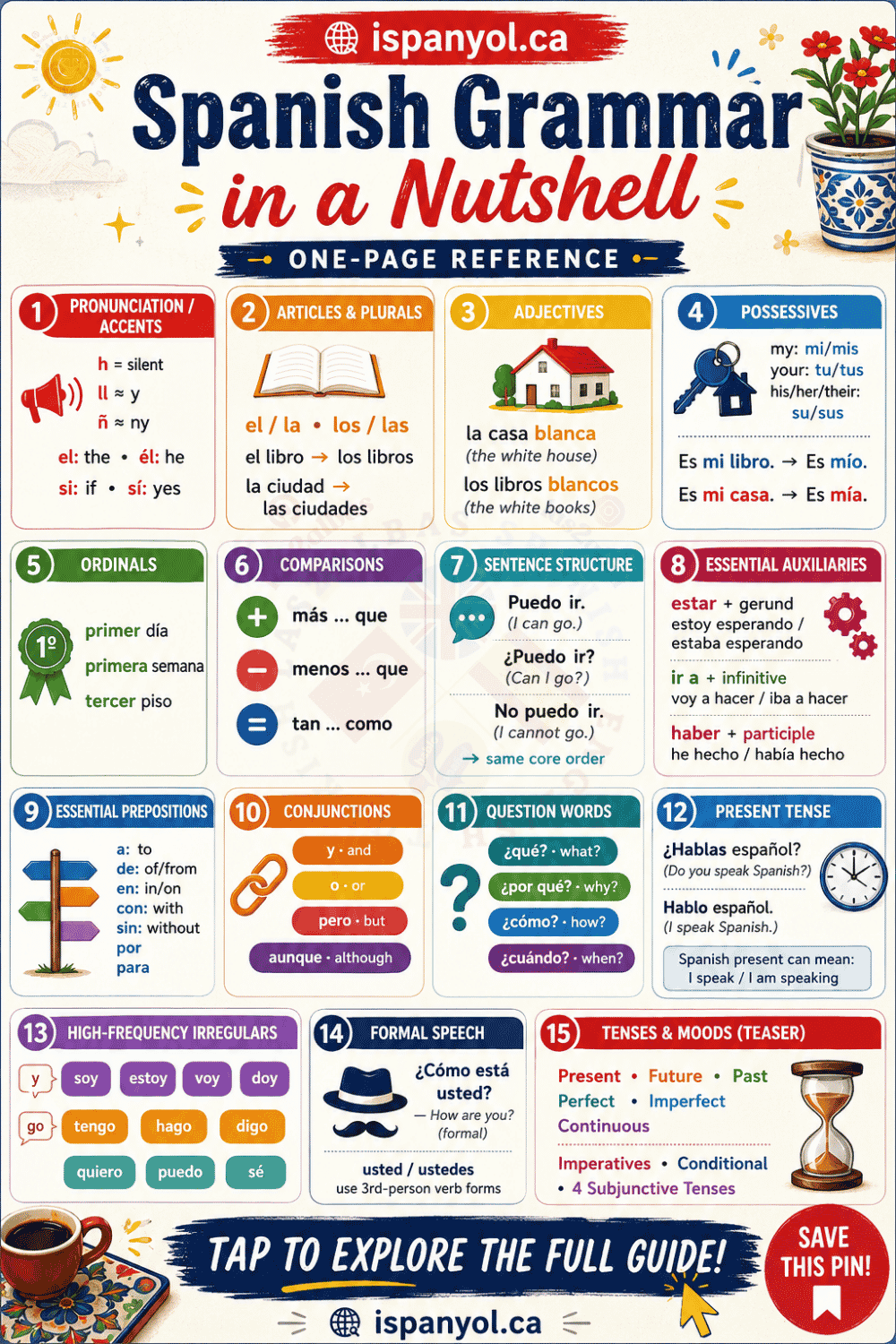
Spanish Grammar in a Nutshell · One-Page Reference
See the essential rule immediately, then open the card for the explanation, conjugation pattern and everyday examples. Designed for fast review from beginner to intermediate level.
These are the high-impact rules worth memorizing first.
Pronunciation
h is silent.
hola sounds like “ola.”
Accent Marks
el: the · él: he
si: if · sí: yes
Gender
-o is often masculine; -a is often feminine.
Useful pattern—not a perfect rule.
Agreement
Articles and adjectives match the noun.
las casas blancas
Negation
Put no before the conjugated verb.
No lo sé. — I don’t know.
Ser / Estar
ser defines; estar locates or describes a state.
More reliable than “permanent vs temporary.”
There is / are
hay works with singular and plural nouns.
Hay un libro. Hay dos libros.
Gustar
gusta for one thing/action; gustan for plural things.
Me gusta viajar. Me gustan los libros.
Future
ir a + infinitive is the easiest future.
Voy a estudiar.
Past
Preterite = completed event; imperfect = background or repeated past.
Fui vs iba
Commands
Positive and negative tú commands use different forms.
¡Habla! / ¡No hables!
Subjunctive
Use it for wishes, doubt, emotion, advice and uncertainty.
Espero que venga.
Without a written accent, words ending in a vowel, n or s are normally stressed on the next-to-last syllable. Other words are normally stressed on the last syllable.
| Without accent | With accent | Meaning contrast |
|---|---|---|
| el | él | the / he |
| tu | tú | your / you |
| mi | mí | my / me |
| si | sí | if / yes |
| te | té | you / tea |
| que, como, cuando | qué, cómo, cuándo | connector / question or exclamation word |
| Singular | Plural | Example | |
|---|---|---|---|
| Masculine definite | el | los | el libro / los libros |
| Feminine definite | la | las | la casa / las casas |
| Masculine indefinite | un | unos | un libro / unos libros |
| Feminine indefinite | una | unas | una casa / unas casas |
Algún and alguno are not two different words; they are two forms of the exact same word. The base word has four regular gender and number forms:
⚡ Golden Rule: Algún = alguno before a masculine singular noun. Only the masculine singular loses the final -o. Feminine and plural forms never drop a letter.
algún libro
alguno without -o before a masculine singular noun (some / any book)
alguno
The noun is already known or omitted (one / any one of them)
Tengo muchos libros. ¿Quieres alguno?
I have many books. Do you want one?
¿Hay algún restaurante cerca? → ¿Hay alguno cerca?
Is there one nearby?
Spanish shortens four common words before a masculine singular noun. When the noun is dropped, the full form returns immediately:
| Before a noun | Noun omitted | Clear sentence comparison |
|---|---|---|
| un libro | uno | ¿Quieres un café? → Sí, quiero uno. |
| algún libro | alguno | Tengo muchos libros. ¿Quieres alguno? |
| ningún libro | ninguno | No tengo ningún libro. → No tengo ninguno. |
| cualquier libro | cualquiera | Puedes elegir cualquier libro. → Puedes elegir cualquiera. |
| Owner | Singular thing | Plural things | Key rule |
|---|---|---|---|
| yo | mi libro | mis libros | number only |
| tú | tu casa | tus casas | number only |
| él / ella / usted | su coche | sus coches | number only |
| nosotros | nuestro libro / nuestra casa | nuestros libros / nuestras casas | gender + number |
| vosotros | vuestro libro / vuestra casa | vuestros libros / vuestras casas | gender + number |
| ellos / ustedes | su idea | sus ideas | number only |
Possessive pronouns replace the noun and agree with the thing possessed: mío, mía, míos, mías; tuyo, tuya, tuyos, tuyas; and so on.
| Distance | Masculine | Feminine | Plural |
|---|---|---|---|
| near the speaker | este | esta | estos / estas |
| near the listener / not very near | ese | esa | esos / esas |
| far from both | aquel | aquella | aquellos / aquellas |
Cardinals: uno, dos, tres, cuatro, cinco, seis, siete, ocho, nueve, diez.
Ordinals: primero, segundo, tercero, cuarto, quinto, sexto, séptimo, octavo, noveno, décimo.
más / menos + adjective + que
Es más alto que yo.
tan + adjective + como
Es tan rápido como tú.
tanto/a/os/as + noun + como
Tengo tantos libros como ella.
verb + tanto como
Trabajo tanto como tú.
For a fuller guide to subject, object, reflexive and possessive pronouns, see our Spanish Pronouns Guide.
Puedo ir. — I can go.
¿Puedo ir? — Can I go?
No puedo ir. — I cannot go.
Spanish does not add an English-style auxiliary such as do. In yes/no questions, the words may remain unchanged; written question marks and spoken intonation show the question.
yo, tú, él/ella/usted, nosotros/as, vosotros/as, ellos/ellas/ustedes
The verb ending usually identifies the subject, so pronouns are commonly omitted unless contrast or emphasis is needed.
Trabajo aquí. — I work here.
Yo trabajo aquí, pero él trabaja allí.
Use the same verb forms as él/ella.
¿Cómo está usted? — How are you?
Hable más despacio, por favor. — Speak more slowly, please.
Use the same verb forms as ellos/ellas.
¿Cómo están ustedes? — How are you all?
Pasen, por favor. — Come in, please.
| Person | Direct object | Indirect object | Example |
|---|---|---|---|
| me | me | me | Me ve. / Me da el libro. |
| you informal | te | te | Te veo. / Te escribo. |
| him / her / it / you formal | lo / la | le | La veo. / Le hablo. |
| us | nos | nos | Nos conocen. / Nos ayudan. |
| you plural informal | os | os | Os veo. / Os digo la verdad. |
| them / you plural | los / las | les | Los conozco. / Les escribo. |
llamarse: me llamo, te llamas, se llama, nos llamamos, os llamáis, se llaman.
| Person | Pronoun | Example |
|---|---|---|
| to me | me | Me gusta esta canción. |
| to you | te | Te gustan los perros. |
| to him/her/you formal | le | Le gusta cocinar. |
| to us | nos | Nos gusta la ciudad. |
| to you plural informal | os | Os gustan estas fotos. |
| to them/you plural | les | Les gusta aprender. |
soy, eres, es, somos
estoy, estás, está, estamos
| Form | Main idea | Example |
|---|---|---|
| hay | there is / there are | Hay una mesa. Hay dos mesas. |
| había | there was/were; background or ongoing past | Había mucha gente. |
| hubo | there was/were; completed event | Hubo un problema. |
| habrá | there will be | Habrá una reunión mañana. |
| ha habido | there has/have been | Ha habido cambios. |
estoy · I am esperando — I am waiting.
estaba · I was esperando — I was waiting.
voy a · I am going to hacer — I am going to do.
iba a · I was going to hacer — I was going to do.
he · I have hecho — I have done.
había · I had hecho — I had done.
Forms below follow the compact order yo, tú, él/ella/usted, nosotros/as.
| Auxiliary | Present | Imperfect | Main use |
|---|---|---|---|
| estar | estoy, estás, está, estamos | estaba, estabas, estaba, estábamos | continuous forms |
| ir | voy, vas, va, vamos | iba, ibas, iba, íbamos | ir a + infinitive |
| haber | he, has, ha, hemos | había, habías, había, habíamos | perfect tenses |
| Preposition | Core meanings | Example |
|---|---|---|
| a | to, at; personal a | Voy a Madrid. Veo a Ana. |
| de | of, from, about | Soy de México. La casa de Juan. |
| en | in, on, at; by transport | Estoy en casa. Voy en tren. |
| con | with | Café con leche. |
| sin | without | Agua sin gas. |
| por | because of, through, by, exchange | Gracias por venir. Por teléfono. |
| para | purpose, recipient, destination, deadline | Es para ti. Estudio para aprender. |
| Word | Meaning | Example |
|---|---|---|
| qué | what | ¿Qué quieres? |
| por qué | why | ¿Por qué estudias español? |
| cómo | how / what…like | ¿Cómo estás? |
| quién / quiénes | who | ¿Quién viene? |
| cuándo | when | ¿Cuándo empieza? |
| cuál / cuáles | which / what one | ¿Cuál prefieres? |
| cuánto/a/os/as | how much / many | ¿Cuánto cuesta? |
| dónde / adónde | where / where to | ¿Dónde estás? ¿Adónde vas? |
Compact order in every table: yo, tú, él/ella/usted, nosotros/as. The other persons follow the same tense pattern.
stem + present ending
| Verb | yo | tú | él/ella | nosotros |
|---|---|---|---|---|
| hablar | hablo | hablas | habla | hablamos |
| comer | como | comes | come | comemos |
| vivir | vivo | vives | vive | vivimos |
present of ir + a + infinitive
| Action | yo | tú | él/ella | nosotros |
|---|---|---|---|---|
| hablar | voy a hablar | vas a hablar | va a hablar | vamos a hablar |
| comer | voy a comer | vas a comer | va a comer | vamos a comer |
| vivir | voy a vivir | vas a vivir | va a vivir | vamos a vivir |
infinitive + é, ás, á, emos
| Verb | yo | tú | él/ella | nosotros |
|---|---|---|---|---|
| hablar | hablaré | hablarás | hablará | hablaremos |
| comer | comeré | comerás | comerá | comeremos |
| vivir | viviré | vivirás | vivirá | viviremos |
| Verb | yo | tú | él/ella | nosotros |
|---|---|---|---|---|
| hablar | hablé | hablaste | habló | hablamos |
| comer | comí | comiste | comió | comimos |
| vivir | viví | viviste | vivió | vivimos |
he, has, ha, hemos + -ado / -ido
| Verb | yo | tú | él/ella | nosotros |
|---|---|---|---|---|
| hablar | he hablado | has hablado | ha hablado | hemos hablado |
| comer | he comido | has comido | ha comido | hemos comido |
| vivir | he vivido | has vivido | ha vivido | hemos vivido |
| Verb | yo | tú | él/ella | nosotros |
|---|---|---|---|---|
| hablar | hablaba | hablabas | hablaba | hablábamos |
| comer | comía | comías | comía | comíamos |
| vivir | vivía | vivías | vivía | vivíamos |
present estar + -ando / -iendo
| Action | yo | tú | él/ella | nosotros |
|---|---|---|---|---|
| hablar | estoy hablando | estás hablando | está hablando | estamos hablando |
| comer | estoy comiendo | estás comiendo | está comiendo | estamos comiendo |
| vivir | estoy viviendo | estás viviendo | está viviendo | estamos viviendo |
estaba, estabas, estaba, estábamos + gerund
| Action | yo | tú | él/ella | nosotros |
|---|---|---|---|---|
| hablar | estaba hablando | estabas hablando | estaba hablando | estábamos hablando |
| comer | estaba comiendo | estabas comiendo | estaba comiendo | estábamos comiendo |
| vivir | estaba viviendo | estabas viviendo | estaba viviendo | estábamos viviendo |
había, habías, había, habíamos + participle
Regular forms match the third-person singular present:
habla, come, vive
Important irregulars:
di, haz, ve, pon, sal, sé, ten, ven
Use no + present subjunctive:
no hables, no comas, no vivas
Irregular examples:
no digas, no hagas, no vayas, no pongas, no seas, no tengas, no vengas
infinitive + ía, ías, ía, íamos
| Verb | yo | tú | él/ella | nosotros |
|---|---|---|---|---|
| hablar | hablaría | hablarías | hablaría | hablaríamos |
| comer | comería | comerías | comería | comeríamos |
| vivir | viviría | vivirías | viviría | viviríamos |
Indicative: presented as fact
Creo que viene.
I think he/she is coming.
Sé que es verdad.
I know it is true.
Subjunctive: reaction or uncertainty
Espero que venga.
I hope he/she comes.
No creo que sea verdad.
I do not think it is true.
Ojalá venga. — I hope he/she comes.
The event is present or future and still possible.
Ojalá haya venido. — I hope he/she has come.
The action may already be complete, but the result is unknown or emotionally relevant now.
Ojalá viniera. — I wish he/she would come.
Often expresses a less likely, difficult or counterfactual wish about the present or future.
Ojalá hubiera venido. — I wish he/she had come.
The past cannot be changed; the speaker regrets or imagines a different past result.
Compact order: yo, tú, él/ella/usted, nosotros/as.
| Verb | Meaning | Four forms |
|---|---|---|
| ser | to be | soy, eres, es, somos |
| estar | to be | estoy, estás, está, estamos |
| ir | to go | voy, vas, va, vamos |
| dar | to give | doy, das, da, damos |
| tener | to have | tengo, tienes, tiene, tenemos |
| hacer | to do/make | hago, haces, hace, hacemos |
| decir | to say/tell | digo, dices, dice, decimos |
| querer | to want/love | quiero, quieres, quiere, queremos |
| poder | can / to be able | puedo, puedes, puede, podemos |
| saber | to know | sé, sabes, sabe, sabemos |
-AR → -ando: hablar → hablando
-ER/-IR → -iendo: comer → comiendo; vivir → viviendo
Common irregulars: leyendo, durmiendo, diciendo, haciendo, yendo.
-AR → -ado: hablar → hablado
-ER/-IR → -ido: comer → comido; vivir → vivido
Common irregulars: hecho, dicho, visto, puesto, escrito, abierto, vuelto, roto.
al and del do not normally contract before a proper name that contains El: Voy a El Salvador.
Continue learning