Spanish Grammar Guide
Spanish Subjunctive Explained (El Subjuntivo)
The subjunctive is not a tense; it is a mood. Spanish uses it when the sentence is not simply reporting a fact, but expressing a wish, doubt, emotion, recommendation, uncertainty or future condition.
The Fastest Way to Understand the Spanish Subjunctive
Desire & Emotion
Use it after phrases like quiero que, espero que and me alegro de que.
Espero que estés bien.
Doubt & Uncertainty
Use it when you are not presenting something as a fact: no creo que, dudo que, es posible que.
No creo que pueda.
Future Actions
Use it after words like cuando, antes de que and hasta que when the action has not happened yet.
Avísame cuando llegues.
Indicative vs. Subjunctive: Reality vs. Reaction
The indicative presents information as a fact. The subjunctive shows your reaction to that information: hope, doubt, emotion, advice or uncertainty.
Indicative: fact or belief
-
Sé que viene.
I know he/she is coming.
-
Creo que es verdad.
I think it is true.
-
Estoy seguro de que puede venir.
I am sure he/she can come.
Subjunctive: doubt, wish or emotion
-
Espero que venga.
I hope he/she comes.
-
No creo que sea verdad.
I don't think it is true.
-
Ojalá pueda venir.
Hopefully he/she can come.
How to Form the Present Subjunctive
Start from the yo form of the present tense, remove the final -o, then use the opposite vowel endings: -AR verbs take e endings, while -ER/-IR verbs take a endings.
| Verb | Present Indicative | Present Subjunctive | Example |
|---|---|---|---|
| hablar | hablo | hable, hables, hable | Quiero que hables. |
| comer | como | coma, comas, coma | No quiero que comas eso. |
| vivir | vivo | viva, vivas, viva | Espero que vivas bien. |
| tener | tengo | tenga, tengas, tenga | Espero que tengas tiempo. |
Important: Many everyday subjunctive forms come from irregular verbs: sea, esté, tenga, pueda, venga, vaya, haga, diga and sepa.
Common Spanish Subjunctive Triggers
These expressions often trigger the subjunctive when followed by que and a new subject.
Espero que...
I hope that...
Ojalá que...
Hopefully / I hope that...
No creo que...
I don't think that...
Dudo que...
I doubt that...
Es posible que...
It is possible that...
Es importante que...
It is important that...
Te recomiendo que...
I recommend that you...
Me alegro de que...
I am glad that...
Antes de que...
Before...
Cuando...
When... future action
Aunque...
Even if / although...
Para que...
So that / in order that...
Subjunctive Across Different Tenses
Present Subjunctive
Tú siempre me ayudas.
You always help me.
Quiero que me ayudes.
I want you to help me.
Present Perfect Subjunctive
Creo que te ha gustado.
I think you liked it.
Espero que te haya gustado.
I hope you liked it.
Imperfect Subjunctive
Tenía más tiempo.
I had more time.
Ojalá tuviera más tiempo.
I wish I had more time.
Advanced Spanish Grammar · Deep Dive
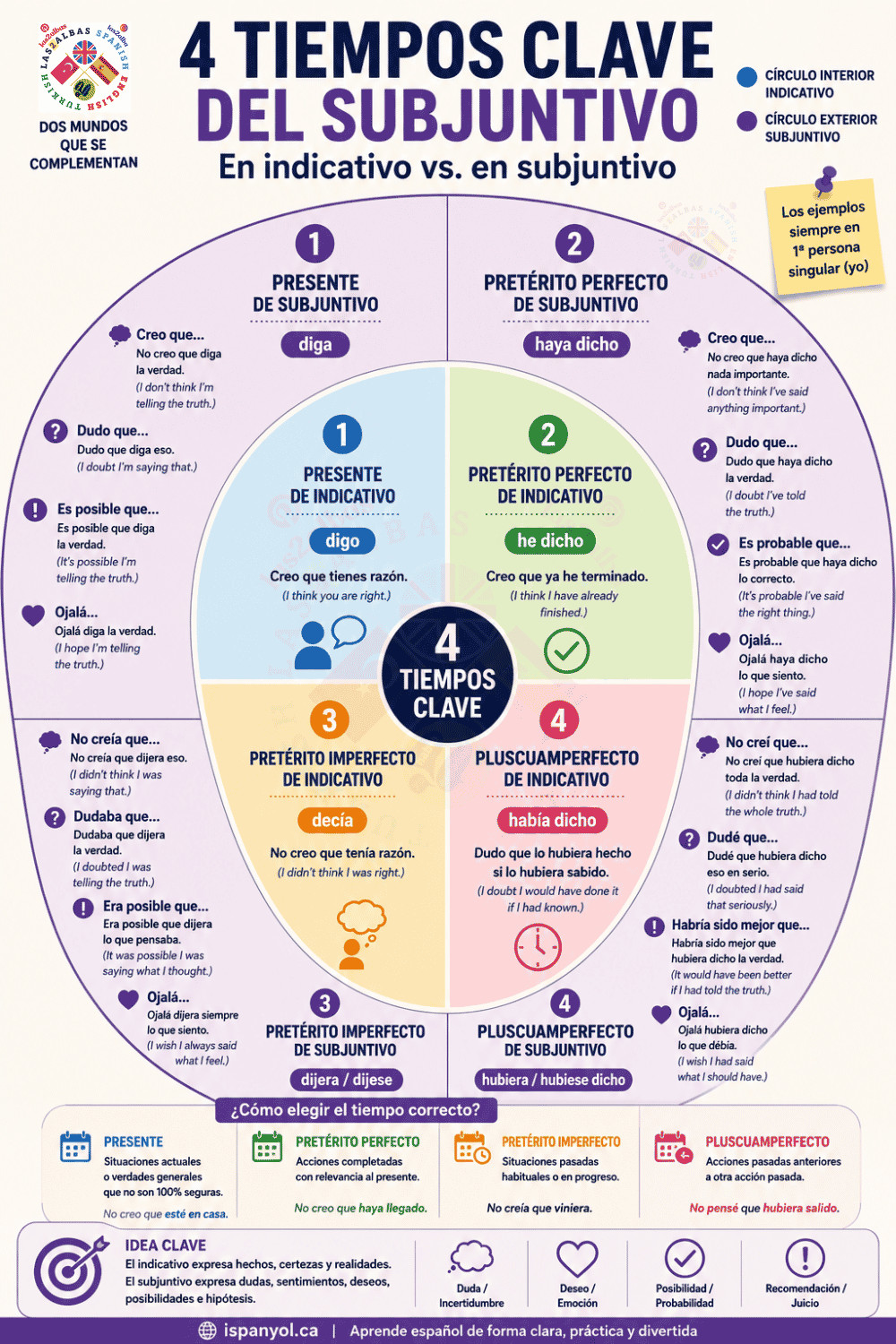
Compare the 4 Main Spanish Subjunctive Tenses
See how the present, present perfect, imperfect and past perfect subjunctive differ in time, meaning and real-life use—with side-by-side examples.
40 Everyday Spanish Subjunctive Phrases You’ll Actually Use
These short phrases are common in messages, conversations, comments, invitations, apologies and daily social situations. Learn them as chunks, not as isolated grammar rules.
Espero que estés bien.
I hope you are well.
Espero que te guste.
I hope you like it.
Espero que le guste.
I hope he/she likes it. / I hope you like it, formal.
Espero que te haya gustado.
I hope you liked it.
Espero que hayas dormido bien.
I hope you slept well.
Espero que todo salga bien.
I hope everything turns out well.
Espero que puedas venir.
I hope you can come.
Espero que nos veamos pronto.
I hope we see each other soon.
Espero que tengas un buen día.
I hope you have a good day.
Espero que disfrutes el viaje.
I hope you enjoy the trip.
No creo que pueda.
I don't think I can.
No creo que sea buena idea.
I don't think it is a good idea.
No creo que tengas razón.
I don't think you are right.
No creo que venga hoy.
I don't think he/she will come today.
No creo que haya ningún problema.
I don't think there is any problem.
Ojalá pueda ir.
Hopefully I can go.
Ojalá tengas suerte.
I hope you have luck.
Ojalá no llueva.
I hope it doesn't rain.
Ojalá sea fácil.
I hope it is easy.
Ojalá lo encuentres.
I hope you find it.
Avísame cuando llegues.
Let me know when you arrive.
Llámame cuando puedas.
Call me when you can.
Dime cuando estés listo.
Tell me when you are ready.
Escríbeme cuando tengas tiempo.
Write/text me when you have time.
Hazlo antes de que se te olvide.
Do it before you forget.
Te llamo cuando salga.
I'll call you when I leave.
Que te vaya bien.
Hope it goes well for you.
Que tengas buen viaje.
Have a good trip.
Que descanses.
Rest well.
Que duermas bien.
Sleep well.
Que lo pases bien.
Have a good time.
Que te mejores pronto.
Get well soon.
Me alegro de que estés aquí.
I am glad you are here.
Me alegra que hayas venido.
I am glad you came.
Siento que no puedas venir.
I am sorry you can't come.
Me sorprende que sepas eso.
I am surprised you know that.
Es mejor que esperes.
It is better that you wait.
Es importante que lo sepas.
It is important that you know it.
Te recomiendo que lo hagas.
I recommend that you do it.
Te aconsejo que no te preocupes.
I advise you not to worry.