Spanish Grammar Essentials
Spanish Prepositions: The Practical Guide
Learn the prepositions that Spanish learners use every day: a, de, en, con, por and para. Start with the most useful examples, then learn the common fixed expressions.
The 6 Spanish Prepositions You Should Learn First
Spanish has many prepositions, but these six appear constantly in daily conversation. If you master these first, most sentences become easier to understand.
A
to, at, personal “a”
Voy a casa.
I’m going home.
DE
of, from, possession
Soy de México.
I’m from Mexico.
EN
in, on, at
Vivo en Madrid.
I live in Madrid.
CON
with, by using, manner
Hablo con Ana.
I’m talking with Ana.
POR
reason, cause, method
Gracias por todo.
Thanks for everything.
PARA
purpose, goal, recipient
Esto es para ti.
This is for you.
Why Prepositions Matter
A Spanish preposition is a small word that connects ideas: place, time, direction, possession, reason, purpose and relationship. The word may be short, but it can change the entire meaning of the sentence.
Incorrect
Vivo Madrid.
Correct
Vivo en Madrid.
I live in Madrid.
The Smart Way to Study Them
Do not memorize prepositions as isolated translations. Learn them as fixed patterns and complete sentences.
- 1.Learn chunks: de hecho, a tiempo, por si acaso.
- 2.Compare pairs: por qué vs para qué, pensar en vs pensar de.
- 3.Use short daily sentences instead of long grammar rules.
Most Common Spanish Prepositions
Here are the basic meanings and simple examples you should know first.
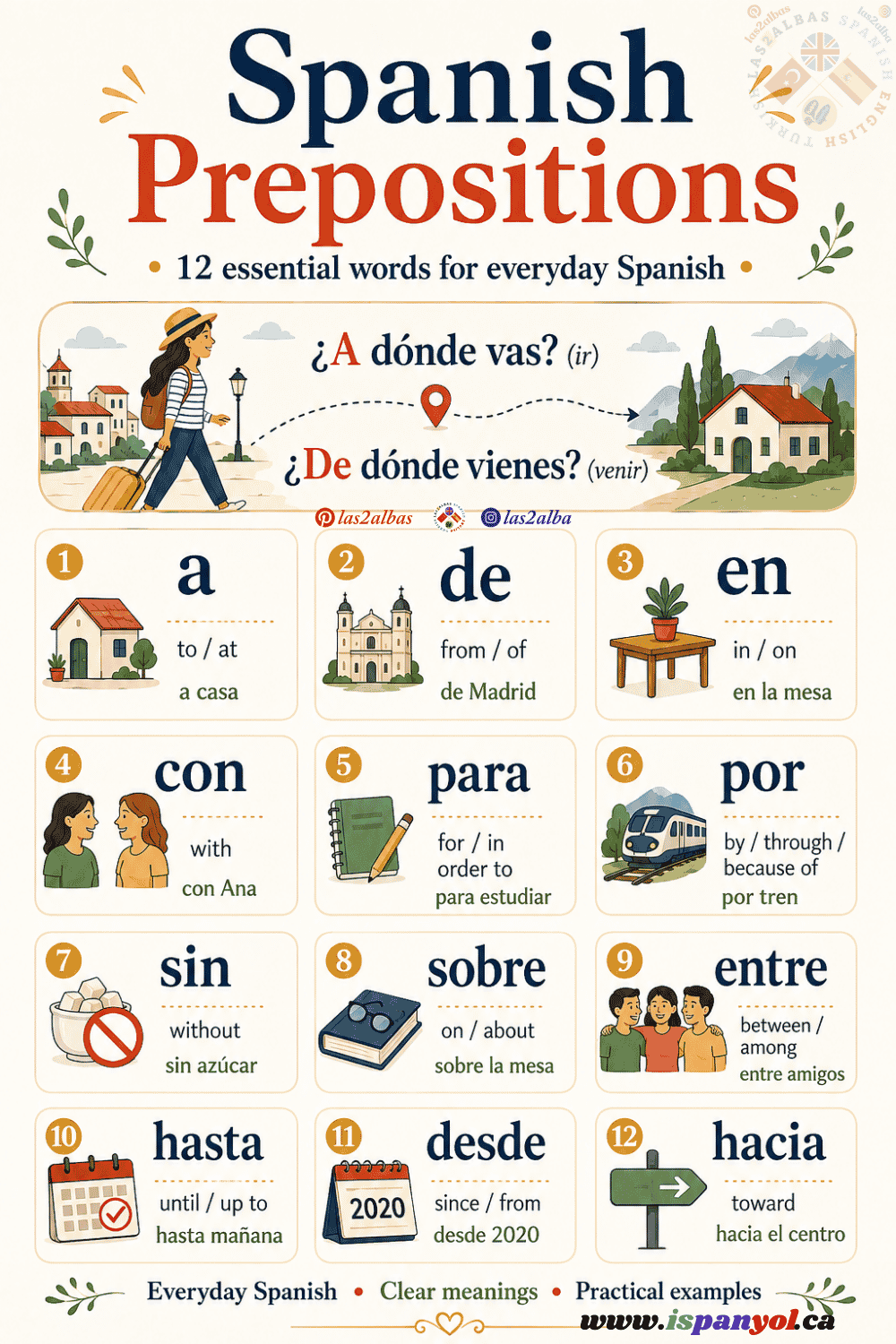
| Preposition | Common Meaning | Spanish Example | English |
|---|---|---|---|
| a | to, at | Voy a la tienda. | I’m going to the store. |
| de | of, from | El libro de María. | María’s book. |
| en | in, on, at | Estoy en casa. | I’m at home. |
| con | with | Trabajo con ella. | I work with her. |
| sin | without | Salí sin dinero. | I left without money. |
| sobre | on, about | Un libro sobre historia. | A book about history. |
| entre | between | Entre tú y yo. | Between you and me. |
| hasta | until, up to | Trabajo hasta las cinco. | I work until five. |
| desde | from, since | Vivo aquí desde mayo. | I’ve lived here since May. |
| hacia | toward | Caminamos hacia el centro. | We walked toward downtown. |
| contra | against | Estoy contra esa idea. | I’m against that idea. |
| durante | during | Durante la clase. | During the class. |
The “Big Six” Prepositions in Daily Spanish
DE
- El coche de mi hermano. My brother’s car.
- Soy de Argentina. I’m from Argentina.
- Una taza de café. A cup of coffee.
- Estoy cansado de esperar. I’m tired of waiting.
A
- Voy a trabajar. I’m going to work.
- Llego a las ocho. I arrive at eight.
- Veo a Laura. I see Laura.
- Aprendo a cocinar. I’m learning to cook.
EN
- Estoy en la oficina. I’m at the office.
- Viajo en tren. I travel by train.
- En verano hace calor. It’s hot in summer.
- Confío en ti. I trust you.
CON
- Vivo con mi familia. I live with my family.
- Lo hice con cuidado. I did it carefully.
- Escribo con lápiz. I write with a pencil.
- Habla con confianza. Speak confidently.
POR
- Lo hice por ti. I did it for you.
- Gracias por venir. Thanks for coming.
- Hablamos por teléfono. We talked by phone.
- Caminamos por el parque. We walked through the park.
PARA
- Esto es para ti. This is for you.
- Trabajo para una empresa. I work for a company.
- Estudio para aprobar. I study to pass.
- El informe es para mañana. The report is due tomorrow.
Crucial Contractions: al & del
When a or de is followed by masculine el, Spanish combines them.
a + el → al
Voy al supermercado. I’m going to the supermarket.
de + el → del
Vengo del banco. I’m coming from the bank.
Common Learner Mistakes
❌ Estoy cansado esperar.
✅ Estoy cansado de esperar.
I’m tired of waiting.
❌ Pienso ti.
✅ Pienso en ti.
I’m thinking about you.
❌ Gracias para ayudarme.
✅ Gracias por ayudarme.
Thanks for helping me.
Por vs Para: The Most Confusing Pair
If you only remember one idea: por usually explains the reason or path, while para points to the goal, use, destination or recipient.
70 Essential Spanish Prepositional Expressions
These fixed expressions are often more useful than grammar rules. Learn them as complete phrases.
Expressions with A
a vecessometimes
a menudooften
a tiempoon time
a pieon foot
a manoby hand
a la vezat the same time
a partir destarting from
a pesar dedespite
a través dethrough
a punto deabout to
Expressions with DE
de hechoin fact
de repentesuddenly
de nuevoagain
de nadayou’re welcome
de verdadreally / truly
de acuerdookay / agreed
de memoriaby heart
de vez en cuandofrom time to time
de díaduring the day
de nocheat night
Expressions with EN
en serioseriously
en realidadactually
en generalin general
en mi opiniónin my opinion
en comúnin common
en voz altaout loud
en resumenin summary
en cuanto aregarding
en lugar deinstead of
en vez deinstead of
Expressions with CON / SIN
con cuidadocarefully
con calmacalmly
con gustogladly
con permisoexcuse me
con razónno wonder
con suertewith luck
sin dudawithout a doubt
sin embargohowever
sin quereraccidentally
sin faltawithout fail
Expressions with POR
por favorplease
por supuestoof course
por finfinally
por esothat’s why
por si acasojust in case
por lo menosat least
por lo generalgenerally
por ahorafor now
por tu propio bienfor your own good
por el amor de Diosfor God’s sake
Expressions with PARA
para siempreforever
para mífor me
para tifor you
para todosfor everyone
para empezarto begin with
para terminarto finish
para nadanot at all
para entoncesby then
para variarfor a change
para queso that
Real Sentences with Prepositions
Use these short sentences as models for your own speaking and writing.
Por supuesto, puedo ayudarte. Of course, I can help you.
Lo hice por tu propio bien. I did it for your own good.
Llegué a tiempo. I arrived on time.
De hecho, tienes razón. In fact, you’re right.
Habla con cuidado. Speak carefully.
Sin duda, es importante. Without a doubt, it’s important.
Lo digo en serio. I’m serious.
Esto es para ti. This is for you.
Practice and Continue Learning
Use these pages to practice prepositions, expressions and common grammar patterns.