Spanish Grammar Guide
Por vs Para in Spanish
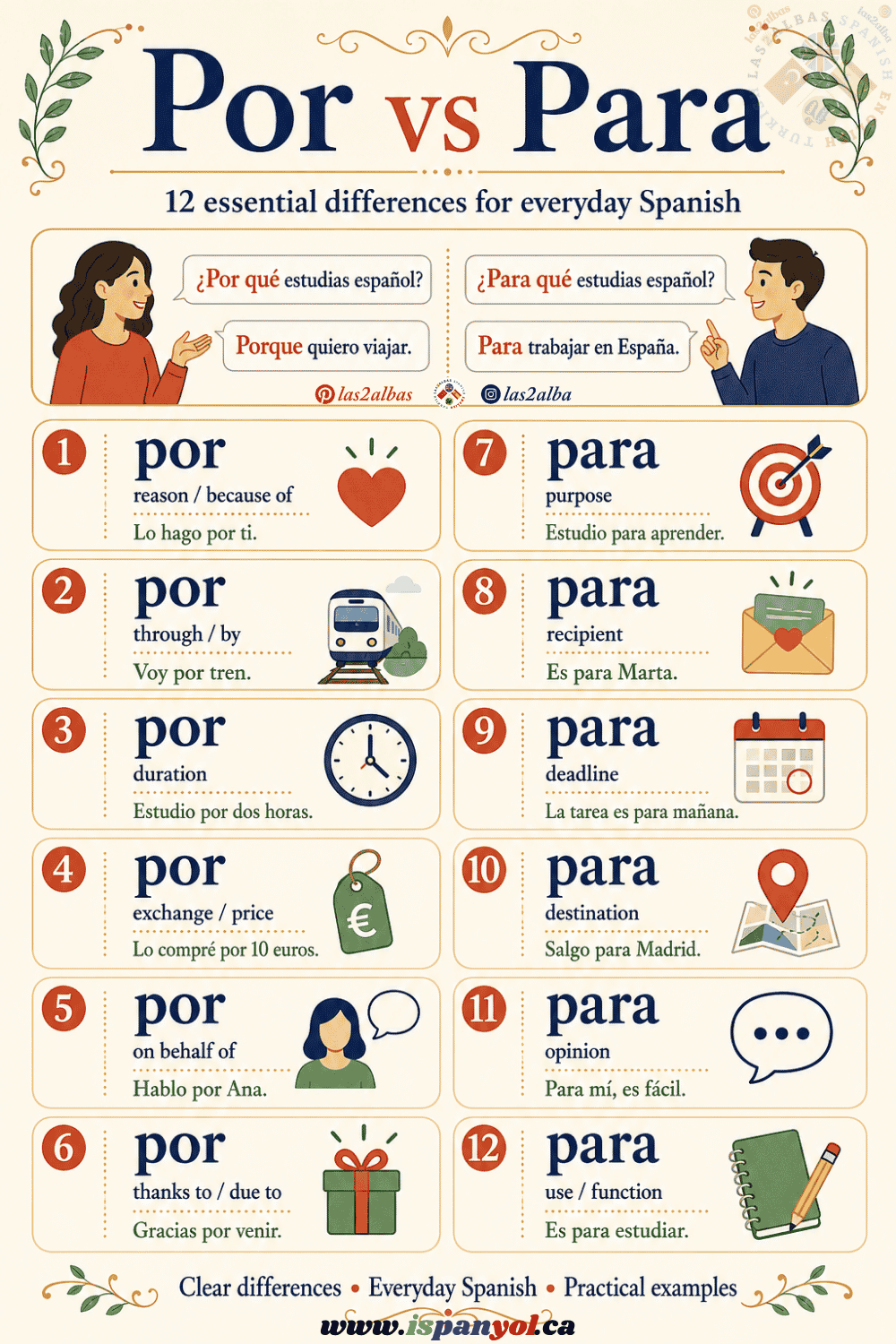
The difference in one sentence: por explains the reason; para explains the objective.
Many Spanish learners struggle with por and para because both often translate as for in English. The fastest way to understand them is to stop translating word by word and focus on the idea behind each preposition.
- POR = Why? Reason, cause, method, exchange, duration, movement through.
- PARA = What for? Purpose, goal, destination, recipient, deadline, intended use.
Por often looks backward to the cause. Para looks forward to the goal.
Quick Comparison
| POR | PARA |
|---|---|
| Reason or cause | Purpose or goal |
| Means or method | Intended result |
| Duration | Deadline |
| Exchange or price | Recipient |
| Movement through/around | Destination |
When to Use POR
Use por when talking about the reason something happens, how something is done, the path of movement, duration, or exchange.
-
1. Reason or Cause
because of, due to, for the sake of
Lo hice por amor.
I did it for love.
-
2. Duration
for, during
Estudié por dos horas.
I studied for two hours.
-
3. Means or Method
by, through, via
Te llamo por teléfono.
I’ll call you by phone.
-
4. Exchange or Price
in exchange for
Pagué veinte dólares por el libro.
I paid twenty dollars for the book.
-
5. Movement Through or Around
through, around, along
Caminamos por el parque.
We walked through the park.
Memory Tip for POR
POR = Cause, Means, Duration, Exchange, Route
Ask yourself: “Why did it happen?” or “How did it happen?” If the answer is a reason, method, duration, price, or route, you probably need por.
When to Use PARA
Use para when talking about goals, destinations, recipients, deadlines, or intended use.
-
1. Purpose
in order to, to
Estudio para aprender.
I study to learn.
-
2. Destination
to, toward, for
Salgo para Madrid mañana.
I’m leaving for Madrid tomorrow.
-
3. Recipient
for
Este regalo es para ti.
This gift is for you.
-
4. Deadline
by
Necesito el informe para el lunes.
I need the report by Monday.
-
5. Intended Use or Opinion
for / considering
Es fácil para mí.
It is easy for me.
Memory Tip for PARA
PARA = Goal, Destination, Purpose, Recipient, Deadline
Ask yourself: “What is the objective?” If you are talking about a goal, recipient, destination, deadline, or intended use, choose para.
The Most Important Difference
The meaning changes depending on whether you use por or para. Compare these sentences:
Trabajo por dinero.
I work for money.
Money is the reasonTrabajo para una empresa.
I work for a company.
Company is the employer¿Por qué? vs ¿Para qué?
This is one of the easiest ways to understand the difference during a conversation.
¿Por qué estudias español?
Why do you study Spanish?
Porque me encantan los idiomas.
Because I love languages. (Reason → POR)
¿Para qué estudias español?
What do you study Spanish for?
Para viajar por América Latina.
To travel around Latin America. (Purpose → PARA)
Quick Test
Choose the correct preposition to complete the sentence.
- Compré este regalo mi hermano.
- Caminamos el centro de la ciudad.
- Estudio español trabajar en México.
- Pagué 15 euros el libro.
- Lo hice ayudarte.
- Gracias tu ayuda.
Show Answers
1. para — recipient
2. por — movement through
3. para — purpose
4. por — exchange
5. para — purpose
6. por — reason/cause
60 Essential Spanish Expressions with POR
These fixed expressions are used constantly in daily Spanish. Learn them as chunks instead of translating each word separately.
-
1. por favor
please
-
2. por supuesto
of course
-
3. por eso
that’s why
-
4. por si acaso
just in case
-
5. por fin
finally
-
6. por ahora
for now
-
7. por lo menos
at least
-
8. por lo general
generally
-
9. por ejemplo
for example
-
10. por suerte
luckily
-
11. por desgracia
unfortunately
-
12. por casualidad
by chance
-
13. por cierto
by the way
-
14. por aquí
around here / this way
-
15. por allí
around there / over there
-
16. por todas partes
everywhere
-
17. por completo
completely
-
18. por escrito
in writing
-
19. por teléfono
by phone
-
20. por correo
by mail
-
21. por internet
online / through the internet
-
22. por mi parte
as for me / on my part
-
23. por tu parte
on your part
-
24. por mi culpa
because of me / my fault
-
25. por culpa de
because of / due to
-
26. por razones personales
for personal reasons
-
27. por motivos de trabajo
for work reasons
-
28. por necesidad
out of necessity
-
29. por obligación
out of obligation
-
30. por error
by mistake
-
31. por accidente
by accident
-
32. por miedo
out of fear
-
33. por amor
for love
-
34. por dinero
for money
-
35. por experiencia
from experience
-
36. por seguridad
for safety
-
37. por tu propio bien
for your own good
-
38. por el bien común
for the common good
-
39. por el amor de Dios
for God’s sake
-
40. por los viejos tiempos
for old times’ sake
-
41. por un lado
on the one hand
-
42. por otro lado
on the other hand
-
43. por una vez
for once
-
44. por primera vez
for the first time
-
45. por última vez
for the last time
-
46. por poco
almost / nearly
-
47. por ahora no
not for now
-
48. por mí está bien
it’s fine by me
-
49. por mí, perfecto
perfect by me
-
50. por lo visto
apparently
-
51. por lo tanto
therefore
-
52. por más que
no matter how much / even though
-
53. por mucho que
no matter how much
-
54. por donde quieras
wherever you want
-
55. por donde pueda
wherever I can
-
56. por aquí cerca
near here
-
57. por la mañana
in the morning
-
58. por la tarde
in the afternoon/evening
-
59. por la noche
at night
-
60. por si no lo sabías
in case you didn’t know
Practice & Related Pages
Continue with quizzes and related grammar pages already available in the site.