Intermediate Spanish Grammar
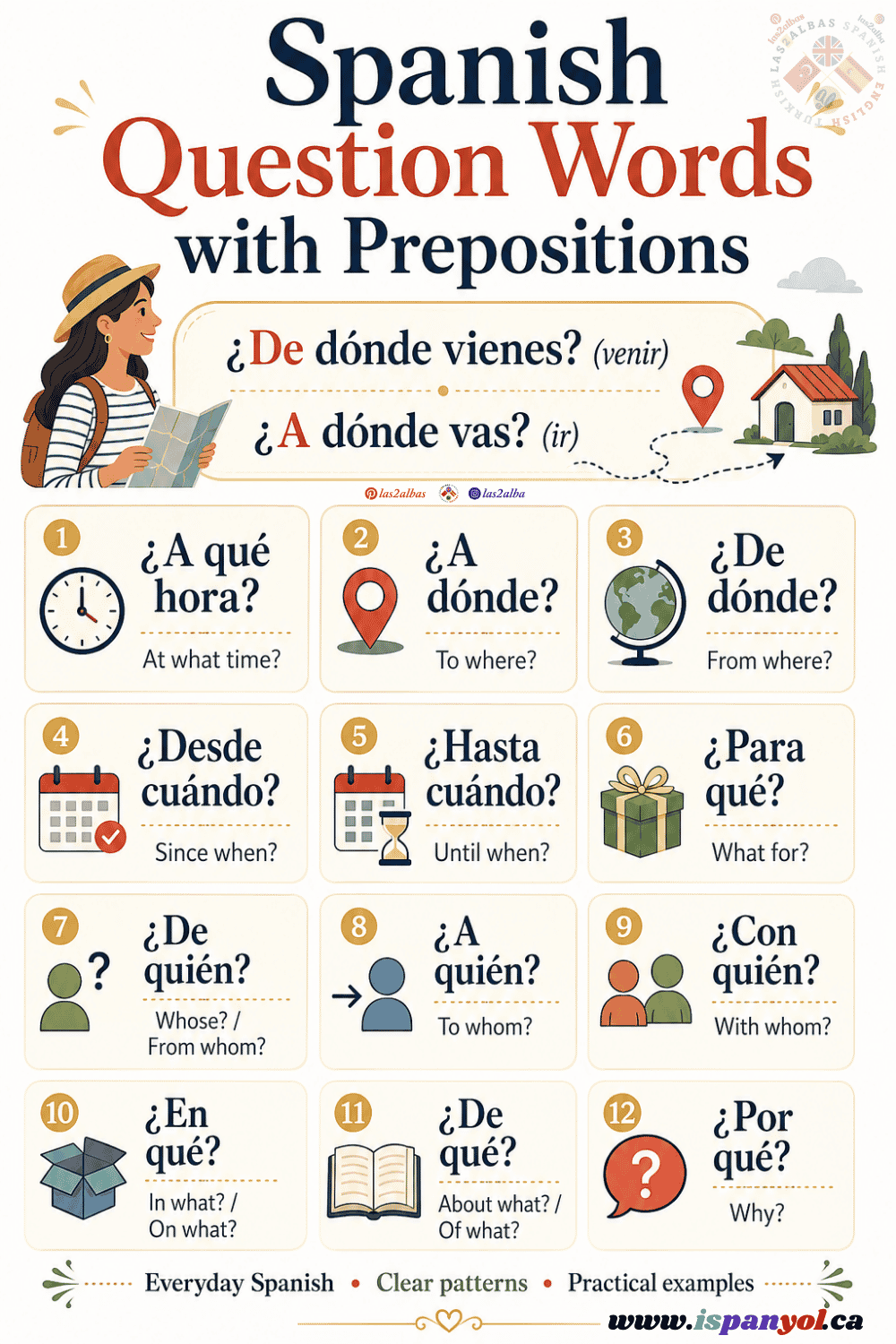
Spanish Question Words with Prepositions
30+ essential patterns for natural conversations. Learn how to combine a, de, en, con, para and por with your question words like a native.
Quick Answer
In Spanish information questions, a required preposition normally comes before the question word. English often leaves the preposition at the end, but Spanish usually keeps the preposition and interrogative together. Instead of asking "Where are you going to?", Spanish speakers ask "To where are you going?" (¿A dónde vas?).
The Golden Rule: No Dangling Prepositions
A Spanish preposition is a small word that connects ideas: place, time, direction, possession, reason, purpose and relationship. However, Spanish places the preposition before the question word — this differs from English, which often leaves the preposition at the end.
English Logic (Incorrect in Spanish)
¿Quién hablas con?
Who are you talking with?
Spanish Logic (Correct)
¿Con quién hablas?
With whom are you talking?
Introduction
Question words and prepositions are two of the most important building blocks of Spanish.
You may already know words like qué, quién, cuándo, dónde and common prepositions such as a, de, con, para, por and en. The next step is learning how native speakers combine them naturally.
Expressions like ¿A dónde vas?, ¿Con quién hablas? or ¿De qué depende? appear constantly in everyday conversations. Want to master prepositions before moving on? Read our complete Spanish Prepositions Guide.
How Are These Questions Formed?
Most Spanish question patterns follow a very simple formula:
Preposition + Question Word = Natural Question
Examples:
- a + dónde → ¿A dónde vas? — Where are you going?
- de + dónde → ¿De dónde eres? — Where are you from?
- con + quién → ¿Con quién estudias? — Who do you study with?
- para + qué → ¿Para qué sirve? — What is it used for?
- desde + cuándo → ¿Desde cuándo vives aquí? — Since when have you lived here?
Movement & Direction: Dónde
The preposition determines whether you are asking about a destination, an origin, a route, a limit, or a starting point.
¿A dónde?
To where? (destination)
- ¿A dónde vas?
Where are you going? - ¿A dónde quieres ir?
Where do you want to go? - ¿A dónde piensas viajar este verano?
Where are you planning to travel this summer?
¿De dónde?
From where? (origin)
- ¿De dónde eres?
Where are you from? - ¿De dónde vienes?
Where are you coming from? - ¿De dónde sacaste esa idea?
Where did you get that idea from?
¿Por dónde?
Which way? (route)
- ¿Por dónde entramos?
Which way do we enter? - ¿Por dónde se llega al centro?
How do you get to downtown?
¿Hasta dónde?
Up to where? (limit)
- ¿Hasta dónde llega esta carretera?
How far does this road go? - ¿Hasta dónde piensas llegar?
How far do you intend to go?
¿Desde dónde?
From where? (starting point)
- ¿Desde dónde llamas?
Where are you calling from? - ¿Desde dónde empieza el recorrido?
Where does the tour start from?
People: Quién / Quiénes
Always place the preposition directly before quién (singular) or quiénes (plural).
¿Con quién? (company)
- ¿Con quién hablas?
Who are you talking to? - ¿Con quién vienes?
Who are you coming with? - ¿Con quién aprendiste español?
Who did you learn Spanish with?
¿De quién? (possession)
- ¿De quién es este coche?
Whose car is this? - ¿De quién es esta mochila?
Whose backpack is this?
¿A quién? (to whom)
- ¿A quién invitaste?
Who did you invite? - ¿A quién le preguntaste?
Who did you ask?
¿Para quién? (recipient)
- ¿Para quién es este regalo?
Who is this gift for? - ¿Para quién cocinas?
Who are you cooking for?
Things & Ideas: Qué
Many Spanish verbs require specific prepositions. When asking a question with one of these verbs, the preposition must lead the sentence.
| Pattern | Spanish Example | English Translation |
|---|---|---|
| ¿De qué? | ¿De qué hablas? | What are you talking about? |
| ¿De qué? | ¿De qué se trata? | What is it about? |
| ¿De qué? | ¿De qué depende? | What does it depend on? |
| ¿De qué? | ¿De qué está hecho? | What is it made of? |
| ¿De qué? | ¿De qué tienes miedo? | What are you afraid of? |
| ¿En qué? | ¿En qué trabajas? | What do you do for a living? |
| ¿En qué? | ¿En qué piensas? | What are you thinking about? |
| ¿En qué? | ¿En qué puedo ayudarte? | What can I help you with? |
| ¿Para qué? | ¿Para qué sirve? | What is it used for? |
| ¿Para qué? | ¿Para qué estudias español? | What are you studying Spanish for? |
| ¿Con qué? | ¿Con qué escribes? | What are you writing with? |
| ¿Con qué? | ¿Con qué dinero pagaste? | What money did you pay with? |
| ¿Sobre qué? | ¿Sobre qué hablaron? | What did they talk about? |
| ¿Acerca de qué? | ¿Acerca de qué estaban hablando? | What were they talking about? |
A useful distinction
¿Por qué? vs. ¿Para qué?
¿Por qué? asks for a reason or cause, while ¿Para qué? asks about a purpose or goal. The questions may look similar, but they invite different kinds of answers.
¿Por qué estudias español?
Why? — reason
Estudio español porque quiero ir a España.
I study Spanish because I want to go to Spain.
¿Para qué estudias español?
What for? — purpose
Estudio español para ir a España.
I study Spanish in order to go to Spain.
Time: Cuándo & Hora
¿Desde cuándo?
- ¿Desde cuándo estudias español?
Since when have you been studying Spanish? - ¿Desde cuándo vives en Madrid?
Since when have you lived in Madrid?
¿Hasta cuándo?
- ¿Hasta cuándo te quedas?
Until when are you staying? - ¿Hasta cuándo dura la oferta?
Until when does the offer last?
¿A qué hora?
- ¿A qué hora empieza la reunión?
At what time does the meeting start? - ¿A qué hora sales del trabajo?
At what time do you get off work?
¿Con qué frecuencia?
- ¿Con qué frecuencia haces ejercicio?
How often do you exercise? - ¿Con qué frecuencia practicas español?
How often do you practice Spanish?
Native Speaker Favorites
Native speakers use these every day.
Common Verb Collocations
The following combinations are extremely common in everyday Spanish. If you're unsure about conjugation, keep our Spanish Grammar Cheat Sheet open while you practice.
| Pattern | Common Verbs |
|---|---|
| ¿De qué...? | depende, se trata, hablas, está hecho, tienes miedo, te acuerdas |
| ¿En qué...? | trabajas, piensas, consiste, puedo ayudarte, te especializas |
| ¿Para qué...? | sirve, necesitas, estudias, quieres, lo haces |
| ¿Con quién...? | hablas, vienes, vas, estudias, trabajas, aprendiste |
| ¿A qué hora...? | empieza, termina, llegas, sales, despiertas, nos vemos |
Everyday Conversation
— Hola. ¿De dónde eres?
— Soy de Colombia.
— ¿Desde cuándo vives aquí?
— Desde hace tres años.
— ¿En qué trabajas?
— Trabajo como diseñador gráfico.
— ¿Con quién vives?
— Vivo con mi esposa.
— ¿A qué hora empiezas a trabajar?
— Normalmente a las ocho.
— ¿Para qué estudias inglés?
— Porque quiero trabajar en una empresa internacional.
— ¿Con qué frecuencia practicas?
— Todos los días.
Learning Tips
Tip: Learn the complete expression. Don't memorize only "qué". Memorize ¿De qué depende? instead.
- Don't memorize individual words: always learn complete patterns.
- Instead of remembering dónde, remember ¿A dónde vas?
- The more complete chunks you learn, the more naturally you'll speak.
Practice Zone
Complete the question:
- _____ dónde eres?
- _____ quién vienes?
- _____ qué sirve?
- _____ qué depende?
- _____ qué hora empieza?
Show Answers
1. De (origin: Where are you from?)
2. Con (company: With whom do you come?)
3. Para (purpose: What is it used for?)
4. De (the verb "depender" always requires "de")
5. A (time: At what time?)
A1–A2 Interactive Practice
Type four short everyday dialogues
Practise patterns such as ¿De dónde?, ¿Con quién?, ¿En qué? and ¿Para qué?.
Frequently Asked Questions
Why do Spanish questions often begin with prepositions?
When a Spanish verb or expression requires a preposition, the preposition normally comes directly before the question word. English often leaves that preposition at the end, but Spanish usually keeps the preposition and interrogative together.
What is the difference between ¿Dónde? and ¿A dónde?
¿Dónde? asks about a location, while ¿A dónde? asks about a destination or direction of movement.
When should I use ¿De qué?
Use ¿De qué? when asking about topics (what something is about), materials (what something is made of), or when a specific verb requires the preposition 'de' (like depender de).
What are the most common Spanish question patterns?
Some of the most common are ¿A dónde vas?, ¿De dónde eres?, ¿Con quién vas?, ¿Para qué sirve?, and ¿De qué depende?.
How can I remember these expressions?
Learn them as complete chunks or phrases instead of translating word by word. Practice matching them with their common verb collocations.
Are these expressions used in everyday conversations?
Yes, they are fundamental to spoken Spanish. Native speakers use these patterns continuously in daily dialogue.
Are they common in DELE exams?
Yes. Correctly using prepositions with question words supports clearer speaking and writing in DELE tasks.
Should I memorize them as chunks?
Yes. Memorizing chunks like '¿En qué piensas?' is much more effective for fluency than trying to combine 'en' + 'qué' + 'piensas' on the fly.