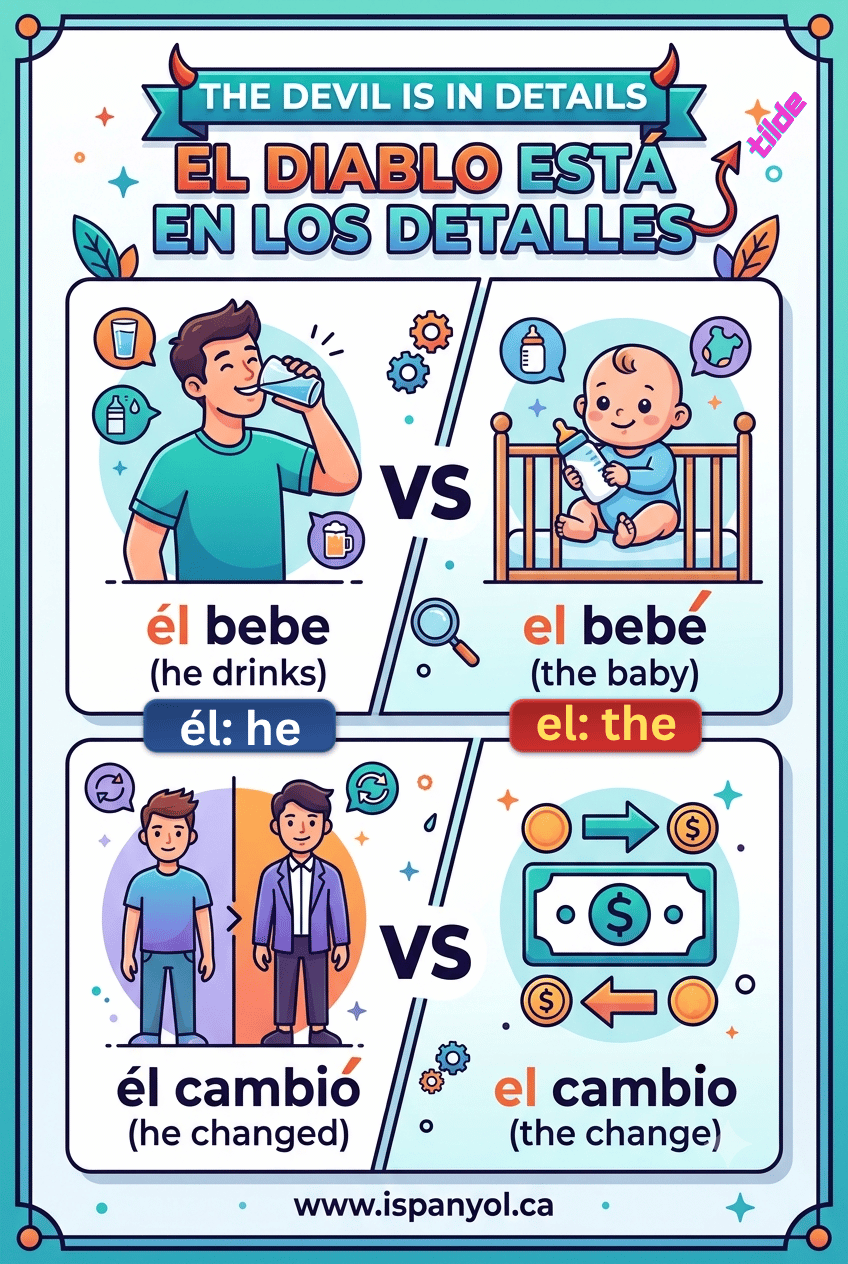
Pequeños detalles, grandes errores
Small details, big mistakes: the most confusing topics in Spanish
The devil is in the details.
El diablo está en los detalles.
There is an unwritten rule among Spanish learners: the more you learn, the more confusing the details become. A single accent mark, a silent letter, or a familiar-looking word can change everything.
What this page helps you notice
This is not a full grammar course. It is a practical map of small Spanish details that often create big misunderstandings. For full grammar explanations, use the Grammar, Deep Dives, and FAQ sections.
False Friends / Falsos amigos
False friends look familiar, but they do not mean what English speakers expect. Focus on the correct meaning first; then notice the English trap.
| Spanish word + correct meaning | Common trap | Useful note |
|---|---|---|
| embarazada (pregnant) | sounds like “embarrassed” | Use avergonzado/a for embarrassed. |
| actualmente (currently) | looks like “actually” | Use en realidad for actually. |
| ropa (clothes) | looks like “rope” | Use cuerda for rope. |
| éxito (success) | sounds like “exit” | Salida means exit. |
| soportar (to tolerate) | looks like “to support” | Use apoyar for support. |
| largo (long) | looks like “large” | Use grande for large/big. |
| mayor (older / greater / main) | can look like “mayor” | Alcalde means mayor of a city. |
| sensible (sensitive) | looks like “sensible” | Use sensato/a for sensible. |
| constipado (having a cold) | looks like “constipated” | In many regions it means a cold / stuffed up. |
The Power of the Accent / Uso de la tilde
A small accent mark is not just decoration. It can separate a pronoun from an article, a verb from a noun, or a statement from a completely different meaning.
yourtú
you
theél
he
ifsí
yes
you / to youté
tea
reflexive pronounsé
I know / be!
mymí
me
but, literarymás
more
that / thanqué
what
as / likecómo
how
whencuándo
when?
wheredónde
where?
who / the one whoquién
who?
Te quiero. I love you.
Quiero té. I want tea.
Él cambió. He changed.
El cambio. The change.
Él bebe agua. He drinks water.
El bebé duerme. The baby sleeps.
No sé. I don’t know.
Se fue. He/She left.
¿Cómo estás? How are you?
Hazlo como quieras. Do it however you want.
¿Cuándo vienes? When are you coming?
Ven cuando quieras. Come whenever you want.
¿Dónde vives? Where do you live?
Déjalo donde estaba. Leave it where it was.
Homophones / Homófonos
Homophones sound the same but have different spellings and meanings. Listening helps, but context is what tells you which word you are hearing.
a ver / haber
A ver... Let's see...
Debe de haber una solución. There must be a solution.
cayó / calló
Se cayó. He/She fell.
Se calló. He/She kept quiet.
vaya / valla
¡Vaya! Wow! / Well!
La valla es alta. The fence is tall.
hecho / echo
Ya está hecho. It is already done.
Echo sal en la sopa. I add salt to the soup.
Polysemy / Polisemia
Spanish loves to reuse words. Without context, many common verbs are impossible to translate with just one English word.
Echar
echar sal to add salt
echar a alguien to throw someone out
echar de menos to miss
Quedar
quedar en casa to stay at home
me queda bien it fits / looks good on me
quedar con amigos to meet friends
Llevar
llevar una bolsa to carry a bag
llevar chaqueta to wear a jacket
llevar a alguien to take someone
Dejar
dejar la casa to leave the house
dejar fumar to allow smoking
dejar de fumar to stop smoking
Tocar
tocar la mesa to touch the table
tocar la guitarra to play the guitar
me toca a mí it is my turn
Ya
Ya terminé. I already finished.
Ya voy. I’m coming now.
¡Ya basta! Enough already!
Hazlo ya. Do it right now.
Ya no lo necesito. I don’t need it anymore.
Basic Spelling Rules / Ortografía básica
o → u
Use u instead of o before words that begin with the /o/ sound.
siete u ocho seven or eight
y → e
Use e instead of y before words that begin with the /i/ sound.
padre e hijo father and son
z → c in plural
Words ending in z usually change to c in the plural.
luz → luces · pez → peces
b / v pronunciation
In standard Spanish, b and v are pronounced the same. Spelling still matters.
botar to bounce / throw away · votar to vote
Punctuation & Expressions / Puntuación y colocaciones
Spanish tells you the emotion first
Questions and exclamations begin and end with signs, so the reader knows the tone before reaching the end.
¿Qué hora es? What time is it?
¡Qué bonito! How beautiful!
Collocations are not word-by-word
In English you “are” many feelings. In Spanish, you often “have” them, or they “give” you something.
tener hambre / sed / años to be hungry / thirsty / [age]
hacer frío / calor to be cold / hot outside
dar miedo / asco to scare / to disgust
Advanced warning
La Caja de Pandora / Pandora’s Box
If your level is A1 or A2, do not worry about mastering everything below yet. These are highly specific cultural and writing details. Learn them gradually when you are ready.
1. Capitalization
Spanish is more conservative with capital letters than English.
Hablo turco y español.
Languages are lowercase.
Nos vemos el lunes.
Days and months are lowercase.
Ayer vi la película La vida es bella en la tele.
In titles, usually only the first word and proper nouns are capitalized.
Compré el libro Cien años de soledad.
The book title is inside the sentence, but only the title’s first word starts with a capital letter.
2. Don, Doña, Señor, Señora
Respect titles depend on whether you use a first name or a last name.
Don Pedro / Doña María
Don / Doña + first name.
Señor García / Señora López
Señor / Señora + last name.
3. Spanish surnames
Traditionally, people use two surnames: one from the father’s side and one from the mother’s side.
First name + father’s first surname + mother’s first surname
Women generally keep their birth surnames after marriage in many Spanish-speaking cultures.
For deeper grammar topics such as ser vs estar, subjunctive, or advanced deep dives, use the full dedicated guides.
Final note
Spanish is full of small details that make a big difference. By learning these confusing topics one by one, you will write more accurately, understand native speakers better, and avoid many common mistakes.