Spanish grammar guide
Spanish Irregular Verbs
Learn the Patterns First
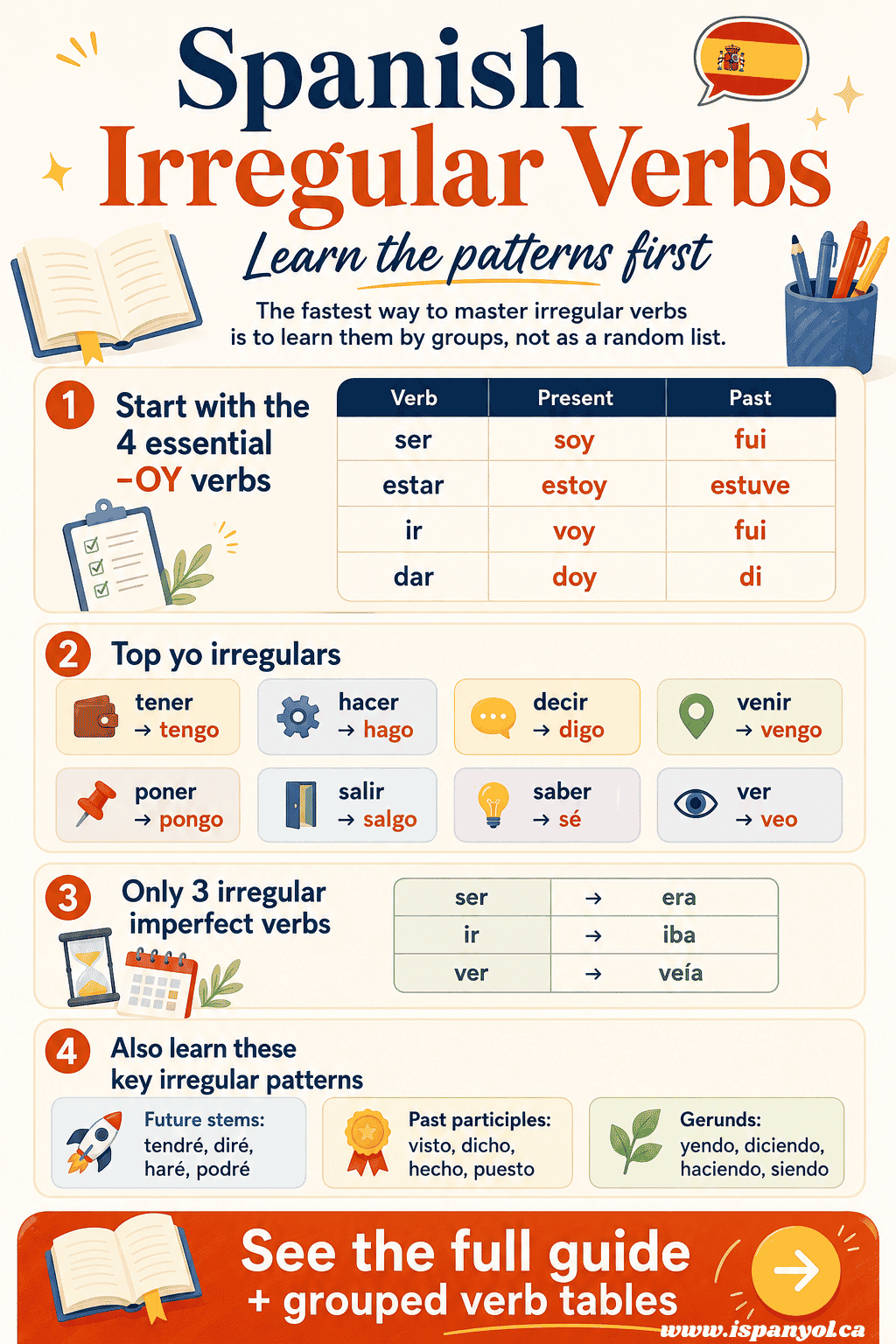
Spanish irregular verbs are easier when you study them by pattern, not as a random list of 100 verbs. Start with the smallest high-value groups first: soy, estoy, voy, doy.
Core irregular-verb pages, different jobs
This page — Pattern map
See how irregularity works across the present, imperfect, future, participles and other high-value forms.
Top 40 — Comparison table
Compare the most important verbs side by side across six essential forms.
Preterite Irregulars — Full Past Guide
Use the full guide for irregular simple-past stems, endings, patterns and meaning nuances.
The Smart Learning Order
Do not try to memorize every irregular verb at once. Learn the most useful groups first, then move to wider lists and quizzes.
1. Tiny core group
ser, estar, ir, dar: the four essential -OY verbs.
2. Present yo forms
tengo, hago, digo, pongo: high-frequency yo irregulars.
3. Time-based groups
Imperfect irregulars, future stems, gerunds, and participles.
4. Wider lists
Use the Top 40 comparison table and targeted quizzes after the patterns make sense.
Start with 4 High-Frequency -OY Forms
These four high-frequency present yo forms all end in -oy. Treat them as a compact memory group rather than a general conjugation rule. They are also important in the simple past.
| Verb | Present yo | Simple past yo | Meaning |
|---|---|---|---|
| ser | soy | fui | I am / I was |
| estar | estoy | estuve | I am / I was |
| ir | voy | fui | I go / I went |
| dar | doy | di | I give / I gave |
Top Present Yo Irregulars
Many essential Spanish verbs have an especially important irregular yo form. Some also change in other persons or tenses, so learn the full verb pattern as you progress.
tener
tengo
to have
hacer
hago
to do / make
decir
digo
to say / tell
venir
vengo
to come
poner
pongo
to put
salir
salgo
to leave / go out
saber
sé
to know
ver
veo
to see
Helpful pattern note
Not every irregular yo form is a “go verb”. conozco, traduzco, sé, veo, voy, estoy, and doy are also irregular, but they do not all follow the classic -go pattern.
Want to see how one irregular pattern spreads through a whole verb family? Compare HACER, DECIR, and PONER.
For positive and negative commands such as ten / no tengas, haz / no hagas, and di / no digas, study the focused go-verbs and commands page below.
Study go verbs and commandsOnly 3 Verbs Are Irregular in the Imperfect Indicative
This is one of the easiest irregular groups in Spanish. In the imperfect indicative, only ser, ir, and ver are irregular.
| Infinitive | Imperfect yo | English |
|---|---|---|
| ser | era | I was |
| ir | iba | I was going / I used to go |
| ver | veía | I was seeing / I used to see |
12 Essential Irregular Future Stems
In the simple future, the endings stay regular, but these verbs use irregular stems: tener → tendré, hacer → haré, decir → diré. This is only the overview; the dedicated future-irregulars page groups all 12 stems by pattern and adds everyday expressions.
| Infinitive | Future yo | Stem | Example |
|---|---|---|---|
| tener | tendré | tendr- | Tendré tiempo. |
| venir | vendré | vendr- | Vendré mañana. |
| poner | pondré | pondr- | Pondré la mesa. |
| salir | saldré | saldr- | Saldré temprano. |
| valer | valdré | valdr- | Valdrá la pena. |
| decir | diré | dir- | Te diré la verdad. |
| hacer | haré | har- | Lo haré después. |
| poder | podré | podr- | No podré venir. |
| querer | querré | querr- | Querré saber más. |
| saber | sabré | sabr- | Lo sabré pronto. |
| caber | cabré | cabr- | No cabrá aquí. |
| haber | habré | habr- | Habrá mucha gente. |
Irregular Past Participles Used in the Present Perfect
The present perfect is built with he + past participle. The irregular part is usually the participle: visto, dicho, hecho, puesto.
| Infinitive | Present perfect yo | Everyday example |
|---|---|---|
| ver | he visto | Ya lo he visto. |
| decir | he dicho | No te he dicho nada. |
| hacer | he hecho | ¿Qué has hecho? |
| poner | he puesto | He puesto las llaves aquí. |
| volver | he vuelto | He vuelto temprano. |
| morir | he muerto | Me he muerto de risa. |
| escribir | he escrito | Te he escrito un mensaje. |
| abrir | he abierto | He abierto la puerta. |
| romper | he roto | Se ha roto el vaso. |
High-Priority Verbs Irregular in Several Important Forms
After the small groups above, use this comparison table to see the most useful irregular forms across several tenses. The gerund column shows forms used with estar, such as estoy diciendo.
| Infinitive | Present yo | Simple past yo | Imperfect yo | Gerund | Present perfect yo | Future yo |
|---|---|---|---|---|---|---|
| ser | soy | fui | era | siendo | he sido | seré |
| ir | voy | fui | iba | yendo | he ido | iré |
| ver | veo | vi | veía | viendo | he visto | veré |
| tener | tengo | tuve | tenía | teniendo | he tenido | tendré |
| venir | vengo | vine | venía | viniendo | he venido | vendré |
| poner | pongo | puse | ponía | poniendo | he puesto | pondré |
| hacer | hago | hice | hacía | haciendo | he hecho | haré |
| decir | digo | dije | decía | diciendo | he dicho | diré |
| poder | puedo | pude | podía | pudiendo | he podido | podré |
| querer | quiero | quise | quería | queriendo | he querido | querré |
| saber | sé | supe | sabía | sabiendo | he sabido | sabré |
| salir | salgo | salí | salía | saliendo | he salido | saldré |