Future tense
Spanish Irregular Future Tense Verbs
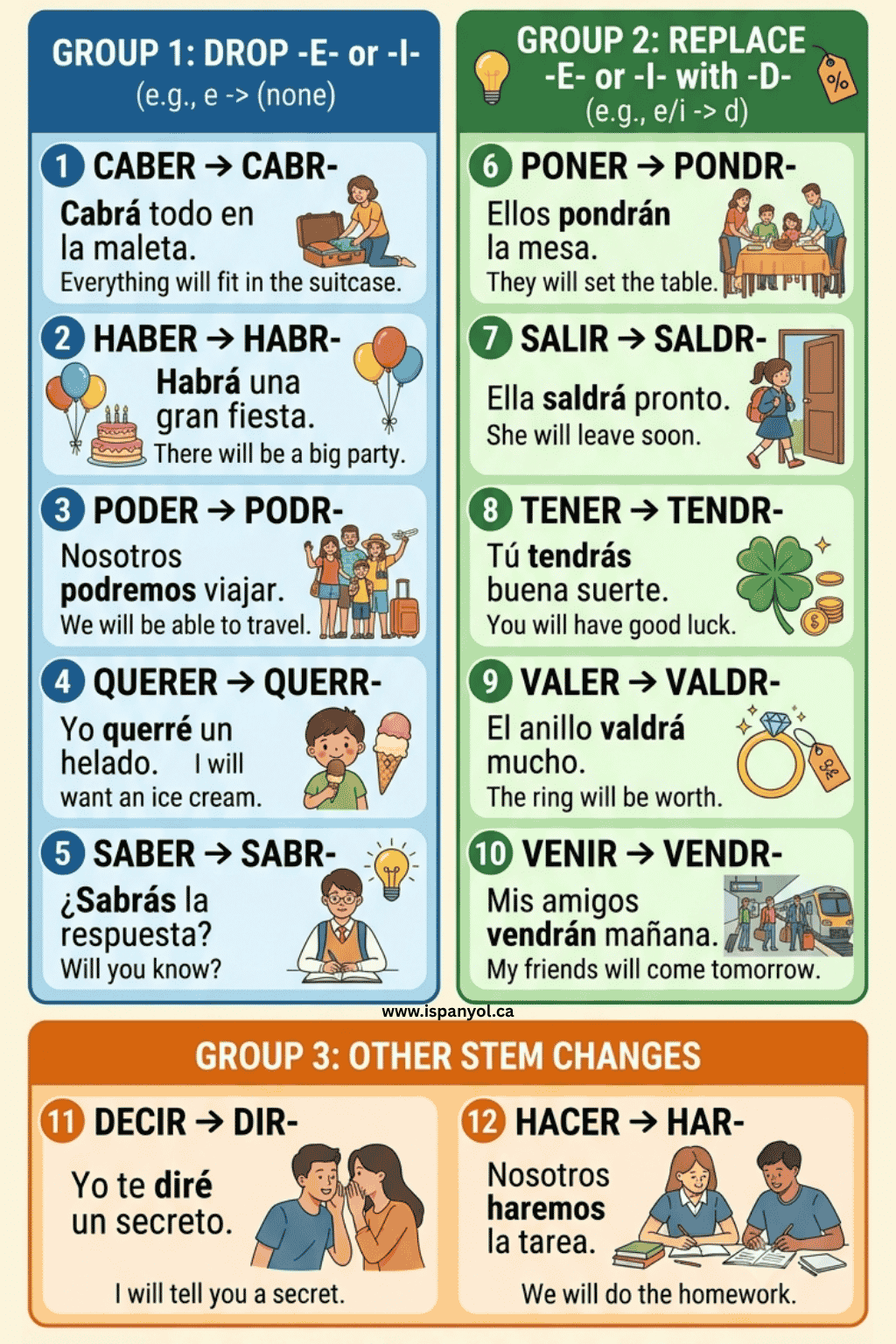
Mastering irregular future verbs is easier when you group them by pattern. This page focuses only on the 12 irregular future stems and the expressions built with them.
Two future pages, two different goals
Future Tense explains the complete system: regular formation, uses, examples and ways to talk about the future. This page is the focused reference for irregular stems such as tendr-, podr-, har- and dir-, plus high-frequency expressions that use them. To compare irregular patterns in the simple past, use the Irregular Preterite guide.
Quick overview
Most useful first
Start with haré, diré, tendré, podré, saldré, querré, vendré and habrá. Then add useful expressions such as valdrá la pena.
Do not change the endings
Future endings stay regular: -é, -ás, -á, -emos, -éis, -án. Only the stem changes. See the Future Tense guide for the regular endings.
3rd person phrases
In common expressions, habrá and valdrá often appear in the 3rd person singular.
The 12 Essential Irregular Future Verbs
Most irregular future verbs follow one of only three stem-change patterns. The colored or crossed-out letters show exactly what changes; the future endings stay regular.
1. Drop the vowel
Drop the vowel before the final -r.
2. Add -dr-
Replace the vowel before the final -r with -d-.
3. Short irregular stems
hacer and decir use shortened stems that are best learned directly: har- and dir-.
Quick endings
har- + é, ás, á, emos, éis, án
dir- + é, ás, á, emos, éis, án
The pattern often continues through a verb family
Once you know the irregular stem of a base verb, many related verbs keep the same future pattern. This is a useful shortcut, not a replacement for learning each verb in context.
tener → tendr-
mantener → mantendré
obtener → obtendré
venir → vendr-
prevenir → prevendré
intervenir → intervendré
Useful 3rd-person patterns: habrá and valdrá
You can conjugate haber and valer in other forms, but habrá and valdrá la pena are especially common 3rd-person singular expressions. In the existential sense, habrá means “there will be”; forms such as habré are usually seen as auxiliaries in the future perfect, for example habré terminado.
Hay → Había → Habrá
- hay: there is / there are
- había: there was / there were
- habrá: there will be
Vale la pena → Valdrá la pena
- vale la pena: it is worth it
- valió la pena: it was worth it
- valdrá la pena: it will be worth it
Daily Expressions with Irregular Future Verbs
Learn these verbs through short sentences. These examples are more useful than memorizing a long chart without context.
Quick Reference: 12 Irregular Future Verbs
The endings are regular. The stem is irregular.
| Infinitive | Future stem | Yo form | Common 3rd-person form |
|---|---|---|---|
| poder | podr- | podré | podrá |
| saber | sabr- | sabré | sabrá |
| haber | habr- | habré | habrá |
| querer | querr- | querré | querrá |
| caber | cabr- | cabré | cabrá |
| tener | tendr- | tendré | tendrá |
| venir | vendr- | vendré | vendrá |
| poner | pondr- | pondré | pondrá |
| salir | saldr- | saldré | saldrá |
| valer | valdr- | valdré | valdrá |
| hacer | har- | haré | hará |
| decir | dir- | diré | dirá |