Spanish Verb Guide
TENER in Spanish
Conjugation, Meanings & Essential TENER Expressions
Tener usually means “to have”, but it is much more than a possession verb. Spanish uses it for age, obligation, physical states, feelings, descriptions and dozens of everyday expressions where English often uses “to be.”
What does tener mean in English?
to have
Its literal meaning is to have / to possess, but many fixed expressions have a different natural English translation.
The key idea for English speakers
Tengo hambre.
I am hungry.
Tienes razón.
You are right.
Tiene suerte.
He / She is lucky.
Spanish is not replacing ser or estar in general. These are simply common expression patterns built with tener + noun.
TENER Visual Study Guide
A quick visual review of present, imperfect and future patterns, plus five everyday expressions where English uses to be but Spanish uses tener.
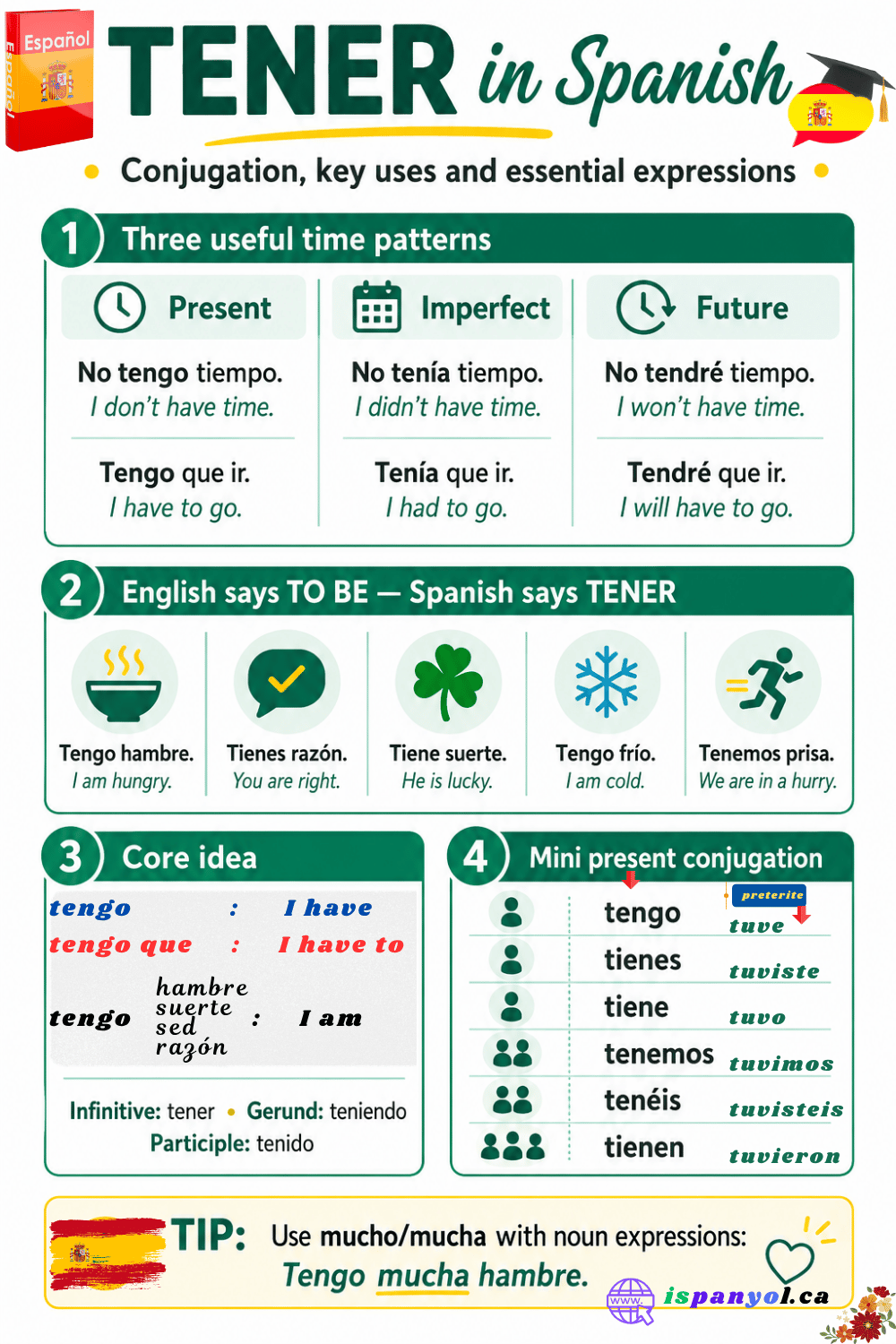
1. Basic Forms of TENER
Infinitive
tener
to have
Gerund
teniendo
having
Past Participle
tenido
had
2. Key TENER Conjugations
These four tenses cover a large share of everyday uses: what you have now, what you had in a completed past event, what you had or used to have over time, and what you will have.
Present
Possession, age, current states and current obligations.
| Pronoun | Form | English |
|---|---|---|
| yo | tengo | I have |
| tú | tienes | you have |
| él / ella / usted | tiene | he / she has; you have |
| nosotros/as | tenemos | we have |
| vosotros/as | tenéis | you all have |
| ellos / ellas / ustedes | tienen | they / you all have |
Preterite
A completed or bounded past situation. Irregular stem: tuv-.
| Pronoun | Form | English |
|---|---|---|
| yo | tuve | I had |
| tú | tuviste | you had |
| él / ella / usted | tuvo | he / she had; you had |
| nosotros/as | tuvimos | we had |
| vosotros/as | tuvisteis | you all had |
| ellos / ellas / ustedes | tuvieron | they / you all had |
Imperfect
Ongoing past situations, background, habits and “used to have.”
| Pronoun | Form | English |
|---|---|---|
| yo | tenía | I had / used to have |
| tú | tenías | you had / used to have |
| él / ella / usted | tenía | he / she had; you had |
| nosotros/as | teníamos | we had / used to have |
| vosotros/as | teníais | you all had / used to have |
| ellos / ellas / ustedes | tenían | they / you all had |
Future
Future possession, states and obligations. Irregular stem: tendr-.
| Pronoun | Form | English |
|---|---|---|
| yo | tendré | I will have |
| tú | tendrás | you will have |
| él / ella / usted | tendrá | he / she will have; you will have |
| nosotros/as | tendremos | we will have |
| vosotros/as | tendréis | you all will have |
| ellos / ellas / ustedes | tendrán | they / you all will have |
Conditional
tendría, tendrías, tendría, tendríamos, tendríais, tendrían
Example: Tendría más tiempo. — I would have more time.
Present Subjunctive
tenga, tengas, tenga, tengamos, tengáis, tengan
Example: Espero que tengas suerte. — I hope you are lucky.
Present Perfect
he tenido, has tenido, ha tenido...
Example: He tenido mucho trabajo. — I have had a lot of work.
3. TENER Across Time: Patterns Worth Memorizing
Learning the same idea in several tenses is one of the fastest ways to make irregular forms feel natural.
Present
No tengo tiempo.
I don't have time.
Tengo que ir.
I have to go.
Imperfect
No tenía tiempo.
I didn't have time.
Tenía que ir.
I had to go / was supposed to go.
Future
No tendré tiempo.
I won't have time.
Tendré que ir.
I will have to go.
One English idea, three Spanish past choices
No he tenido tiempo vs. No tuve tiempo vs. No tenía tiempo
All three can relate to English “I didn’t have time,” but they frame the past differently. Choose the tense according to whether the time period is connected to now, completed, or background/ongoing.
Present perfect
No he tenido tiempo.
I haven’t had time.
Use it when the lack of time belongs to a recent or still-relevant period that connects with the present.
Esta semana no he tenido tiempo de llamarte.
I haven’t had time to call you this week.
Preterite
No tuve tiempo.
I didn’t have time.
Use it for a specific, completed past situation or a finished time period.
Ayer no tuve tiempo de llamarte.
Yesterday I didn’t have time to call you.
Imperfect
No tenía tiempo.
I didn’t have time / I used not to have time.
Use it as background, for an ongoing past circumstance, or for something that was repeatedly true.
Cuando trabajaba allí, no tenía tiempo para cocinar.
When I worked there, I didn’t have time to cook.
Fast memory rule
he tenido → past connected to now; tuve → completed past event or finished period; tenía → background, ongoing state or repeated past situation.
Regional usage varies: in much of Latin America the preterite is often used in contexts where Peninsular Spanish may prefer the present perfect. The contrast above reflects the standard teaching distinction.
4. The Main Uses of TENER
Possession
Use tener to say what someone has or possesses.
Tengo un coche.
I have a car.
Age
Spanish expresses age with tener + number + años.
Ella tiene treinta años.
She is thirty years old.
English “was” → Spanish chooses SER or TENER
Cuando era niño / niña.
When I was a child.
Cuando tenía cinco años.
When I was five years old.
Era comes from ser and describes what you were; tenía comes from tener and expresses age with tener + number + años.
Obligation
Tener que + infinitive means to have to.
Tenemos que trabajar.
We have to work.
Physical states
Many sensations are expressed as nouns possessed with tener.
Tengo frío.
I am cold.
Feelings & reactions
Fear, hurry, luck, reason and similar ideas often use tener.
Tienes razón.
You are right.
Physical description
Hair, eyes and similar features are commonly described with tener.
Tiene los ojos verdes.
He / She has green eyes.
5. 25 Essential Expressions with TENER
These expressions are best learned as complete chunks. The “literal meaning” column helps explain the structure, while the final column gives the natural English translation.
| Expression | Literal idea | Natural English | Example |
|---|---|---|---|
| tener hambre | have hunger | be hungry | Tengo hambre. |
| tener sed | have thirst | be thirsty | ¿Tienes sed? |
| tener frío | have cold | be cold | Tenemos frío. |
| tener calor | have heat | be hot | Tengo calor. |
| tener sueño | have sleep | be sleepy | Ella tiene sueño. |
| tener miedo de | have fear of | be afraid of | Tengo miedo de volar. |
| tener prisa | have haste | be in a hurry | Tenemos prisa. |
| tener razón | have reason | be right | Tienes razón. |
| tener suerte | have luck | be lucky | Hoy tienes suerte. |
| tener éxito | have success | be successful | El proyecto tuvo éxito. |
| tener cuidado | have care | be careful | Ten cuidado. |
| tener paciencia | have patience | be patient | Tienes que tener paciencia. |
| tener vergüenza | have shame | be ashamed / embarrassed | Tiene vergüenza. |
| tener la culpa | have the blame | be at fault | Yo no tengo la culpa. |
| tener ganas de | have desire to | feel like | Tengo ganas de salir. |
| tener que | have to | have to / must | Tengo que estudiar. |
| tener lugar | have place | take place | La reunión tendrá lugar mañana. |
| tener en cuenta | have in account | keep in mind / take into account | Tenlo en cuenta. |
| tener que ver con | have to see with | have to do with | No tiene nada que ver conmigo. |
| tener interés en | have interest in | be interested in | Tengo interés en aprender más. |
| tener confianza en | have confidence in | have confidence in / trust | Tengo confianza en ti. |
| tener experiencia | have experience | have experience | Tiene mucha experiencia. |
| tener problemas | have problems | have problems / be having trouble | Tenemos problemas con el coche. |
| tener tiempo | have time | have time | No tengo tiempo hoy. |
| tener años | have years | be ... years old | Mi hijo tiene ocho años. |
Mucho / mucha — not muy
Because expressions such as hambre, sed, suerte, prisa and paciencia are nouns, they are normally intensified with mucho / mucha: Tengo mucha hambre. Do not say tengo muy hambre.
6. TENER QUE + Infinitive: “To Have To”
Tener que is one of the most useful structures in spoken Spanish. Conjugate tener, keep que, then add an infinitive.
Formula
tener + que + infinitive
Tengo que trabajar.
I have to work.
Tenemos que salir.
We have to leave.
Across tenses
Tengo que ir.
I have to go.
Tenía que ir.
I had to go / was supposed to go.
Tuve que ir.
I had to go. (specific completed situation)
Tendré que ir.
I will have to go.
Tendría que ir.
I would have to go / I should probably go.
Tener que vs. hay que vs. deber
| Structure | Typical idea | Example |
|---|---|---|
| tener que + infinitive | personal necessity / obligation | Tengo que estudiar. — I have to study. |
| hay que + infinitive | general or impersonal necessity | Hay que estudiar. — One has to study / You have to study. |
| deber + infinitive | duty, advice or what someone should do | Debes estudiar. — You should / must study. |
For a deeper comparison, see the Spanish verb DEBER guide.
7. Advanced TENER Collocations
Tener ganas de + infinitive
Use it when you feel like doing something.
Tengo ganas de comer pizza.
I feel like eating pizza.
Tener en cuenta
To keep in mind or take into account.
Hay que tener en cuenta el clima.
You have to take the weather into account.
Tener lugar
Used for an event that takes place.
El concierto tendrá lugar en Madrid.
The concert will take place in Madrid.
Tener que ver con
To have to do with something.
Eso no tiene nada que ver conmigo.
That has nothing to do with me.
Commands with TENER
Affirmative tú
¡Ten cuidado!
Be careful!
¡Ten paciencia!
Be patient!
Negative tú
¡No tengas miedo!
Don't be afraid!
¡No tengas prisa!
Don't be in a hurry!
TENER in the Subjunctive
Present subjunctive: tenga, tengas, tenga, tengamos, tengáis, tengan.
Espero que tengas suerte.
I hope you are lucky.
Me alegra que tengas tiempo.
I'm glad you have time.
No creo que tenga razón.
I don't think he / she is right.
TENER vs. HABER: both can appear as “have” in English
Tener means possession or appears in the expressions on this page. Haber is the auxiliary used to form compound tenses. Do not use tener to translate English “have” in sentences such as “I have eaten.”
Tengo un libro.
I have a book. — possession with tener
He comido.
I have eaten. — compound tense with haber
8. Common Mistakes with TENER
❌ Soy 30 años.
Use tener for age:
✓ Tengo 30 años.
❌ Estoy hambre.
Use the noun expression tener hambre:
✓ Tengo hambre.
❌ Tengo muy hambre.
Hambre is a noun, so use mucha:
✓ Tengo mucha hambre.
❌ Tengo comido.
Compound tenses use haber, not tener:
✓ He comido.
❌ Cuando era cinco años...
Use tener + number + años for age, even in the past:
✓ Cuando tenía cinco años...
But Cuando era niño / niña... is correct because niño/niña describes what you were.
⚠️ “I didn’t have time” is not always one tense.
Choose the tense from the context:
- No he tenido tiempo → up to now / present connection
- No tuve tiempo → completed past situation
- No tenía tiempo → background or ongoing past state
Quick Review
Try to translate these before opening the answers.
1. I am hungry.
Tengo hambre.
2. You are right.
Tienes razón.
3. When I worked there, I didn't have time to cook.
Cuando trabajaba allí, no tenía tiempo para cocinar.
4. We will have to leave.
Tendremos que salir.
5. I feel like traveling.
Tengo ganas de viajar.
6. When I was five years old...
Cuando tenía cinco años...
9. Quick FAQ About TENER
Is tener an irregular verb?
Yes. It has several irregular patterns: tengo in the yo form, stem-changing present forms such as tienes, the preterite stem tuv-, and the future/conditional stem tendr-.
When does tener translate as “to be”?
In several fixed expressions: tener hambre = be hungry, tener sed = be thirsty, tener razón = be right, tener suerte = be lucky, tener miedo = be afraid and tener prisa = be in a hurry.
What is the difference between tuve que and tenía que?
Tuve que usually presents a specific, completed past obligation. Tenía que describes an ongoing, background or expected obligation and does not by itself emphasize completion.
What is the difference between tener and haber?
Tener is used for possession and many everyday expressions. Haber is used as an auxiliary in compound tenses: he comido = I have eaten.
How do you say “I have to” in Spanish?
Use tengo que + infinitive: Tengo que trabajar = I have to work; Tengo que ir = I have to go.
Why is it “cuando era niño” but “cuando tenía cinco años”?
Spanish uses ser to describe identity or a life stage: cuando era niño = when I was a child. Age is expressed with tener + number + años: cuando tenía cinco años = when I was five years old. English uses “was” in both sentences, but Spanish uses two different verbs.
What is the difference between “no he tenido tiempo,” “no tuve tiempo” and “no tenía tiempo”?
No he tenido tiempo means “I haven't had time” and connects the past with the present. No tuve tiempo refers to a specific completed past situation or finished period. No tenía tiempo describes background, an ongoing circumstance or something repeatedly true in the past.
TENER: the pattern to remember
Tener means to have, but many high-frequency Spanish expressions use tener + noun where English naturally uses to be. Learn the expressions as complete chunks and practice them across several tenses.