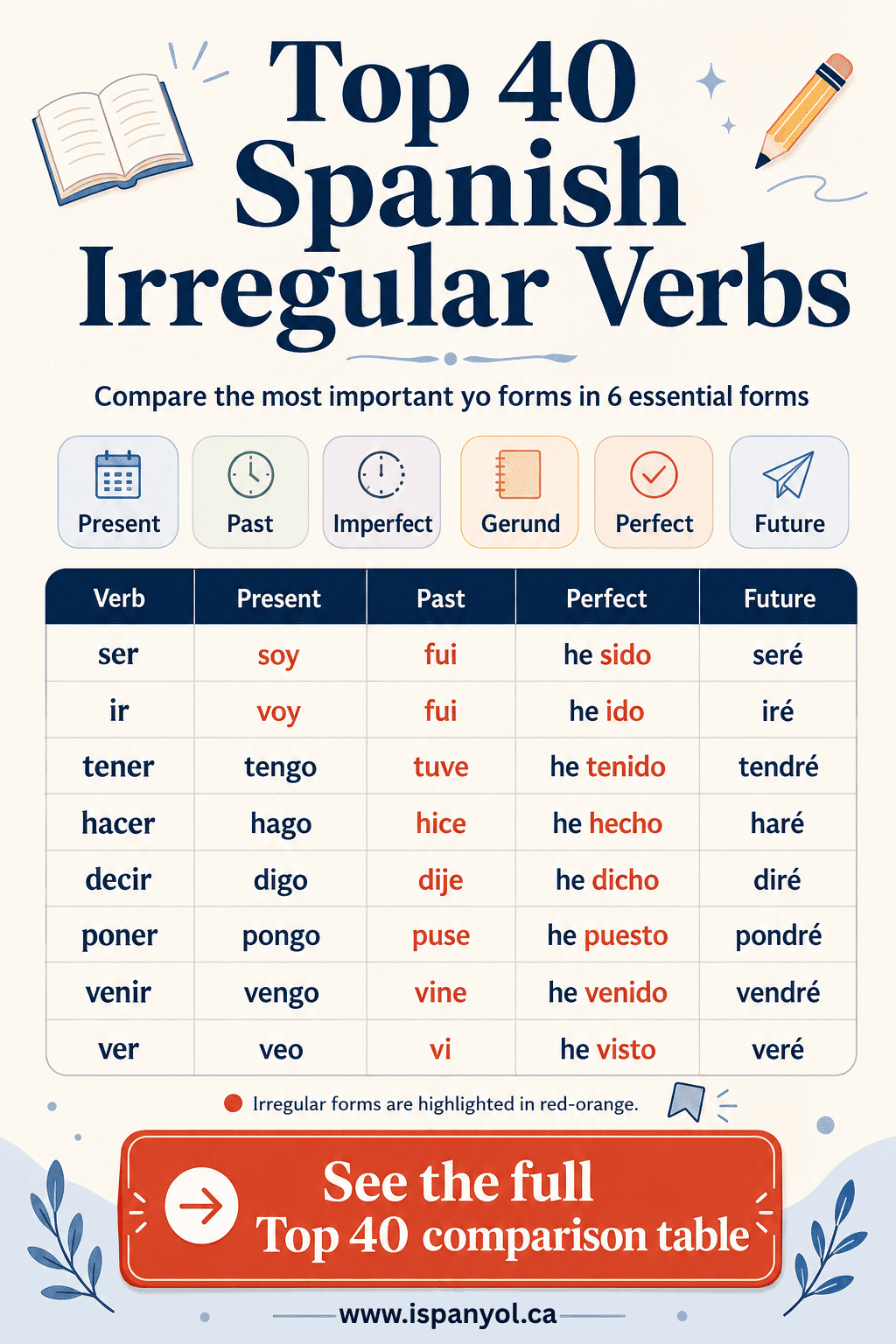
Must-Know Irregulars
Top 40 Spanish Irregular Verbs
Compare 6 essential forms side by side
Use this page as a compact comparison table. Start with the priority verbs, then filter by present irregulars, past irregulars, imperfect forms, gerunds, participles and future stems. If you only need the highest-priority past forms first, start with the A2 Top 10 Preterite Irregulars. For the complete simple-past system before focusing on irregulars, use the Spanish Preterite Tense Guide.
Core irregular-verb pages, different jobs
Start with patterns
Spanish irregular verbs are easier when you compare related forms side by side instead of memorizing a random list.
Red = irregular
The highlighted forms are the ones that deserve extra attention: soy, fui, tuve, hecho, tendré.
Perfect = he + participle
The perfect column shows he visto, he dicho, he puesto and other useful present-perfect forms.
The 6 forms compared here
This is not a full conjugation chart. It is a compact comparison reference. Most columns use yo forms; the gerund is a non-personal form.
Present
soy, tengo
Preterite
fui, hice
Imperfect
era, iba
Gerund
yendo
Present perfect
he visto
Future
tendré
Top 40 comparison table
Showing all 40 verbs.
Tip: on mobile, scroll the table horizontally.
| Verb | Present yo | Preterite yo | Imperfect yo | Gerund | Present perfect yo | Future yo |
|---|---|---|---|---|---|---|
| 01ser to be | soy | fui | era | siendo | he sido | seré |
| 02ir to go | voy | fui | iba | yendo | he ido | iré |
| 03ver to see | veo | vi | veía | viendo | he visto | veré |
| 04tener to have | tengo | tuve | tenía | teniendo | he tenido | tendré |
| Family link: TENER expressions & verb family | ||||||
| 05venir to come | vengo | vine | venía | viniendo | he venido | vendré |
| 06poner to put / place | pongo | puse | ponía | poniendo | he puesto | pondré |
| Family link: PONER deep dive & derived verb family | ||||||
| 07hacer to do / make | hago | hice | hacía | haciendo | he hecho | haré |
| 08decir to say / tell | digo | dije | decía | diciendo | he dicho | diré |
| 09salir to leave / go out | salgo | salí | salía | saliendo | he salido | saldré |
| 10valer to be worth | valgo | valí | valía | valiendo | he valido | valdré |
| 11poder to be able to | puedo | pude | podía | pudiendo | he podido | podré |
| 12querer to want / love | quiero | quise | quería | queriendo | he querido | querré |
| 13saber to know | sé | supe | sabía | sabiendo | he sabido | sabré |
| 14caber to fit | quepo | cupe | cabía | cabiendo | he cabido | cabré |
| 15estar to be | estoy | estuve | estaba | estando | he estado | estaré |
| 16dar to give | doy | di | daba | dando | he dado | daré |
| Deep dive: DAR — conjugation, DARSE & everyday expressions | ||||||
| 17oír to hear | oigo | oí | oía | oyendo | he oído | oiré |
| 18traer to bring | traigo | traje | traía | trayendo | he traído | traeré |
| 19caer to fall | caigo | caí | caía | cayendo | he caído | caeré |
| 20pedir to ask for / order | pido | pedí | pedía | pidiendo | he pedido | pediré |
| 21sentir to feel | siento | sentí | sentía | sintiendo | he sentido | sentiré |
| 22dormir to sleep | duermo | dormí | dormía | durmiendo | he dormido | dormiré |
| 23morir to die | muero | morí | moría | muriendo | he muerto | moriré |
| 24volver to return | vuelvo | volví | volvía | volviendo | he vuelto | volveré |
| 25seguir to follow / continue | sigo | seguí | seguía | siguiendo | he seguido | seguiré |
| 26pensar to think | pienso | pensé | pensaba | pensando | he pensado | pensaré |
| 27encontrar to find | encuentro | encontré | encontraba | encontrando | he encontrado | encontraré |
| 28conocer to know / meet | conozco | conocí | conocía | conociendo | he conocido | conoceré |
| 29conducir to drive | conduzco | conduje | conducía | conduciendo | he conducido | conduciré |
| 30traducir to translate | traduzco | traduje | traducía | traduciendo | he traducido | traduciré |
| 31volar to fly | vuelo | volé | volaba | volando | he volado | volaré |
| 32construir to build | construyo | construí | construía | construyendo | he construido | construiré |
| 33jugar to play | juego | jugué | jugaba | jugando | he jugado | jugaré |
| 34reír to laugh | río | reí | reía | riendo | he reído | reiré |
| 35vestir to dress / wear | visto | vestí | vestía | vistiendo | he vestido | vestiré |
| 36escribir to write | escribo | escribí | escribía | escribiendo | he escrito | escribiré |
| 37abrir to open | abro | abrí | abría | abriendo | he abierto | abriré |
| 38romper to break | rompo | rompí | rompía | rompiendo | he roto | romperé |
| 39andar to walk | ando | anduve | andaba | andando | he andado | andaré |
| 40leer to read | leo | leí | leía | leyendo | he leído | leeré |
Red forms are the forms you should notice first. Some forms are regular but still included for comparison.
Smallest high-value group
ser → soy / fui
estar → estoy / estuve
ir → voy / fui
dar → doy / di
Notice: fui can mean “I was” or “I went”. Context decides.
Only 3 irregular imperfects
ser → era
ir → iba
ver → veía
This is one of the easiest irregular groups to master quickly.
Strong future stems
Learn these as chunks: tendré, vendré, pondré, haré, diré, podré, querré, sabré.
For a focused future-tense guide, use the page below.
Useful example sentences
No sé qué hacer.
I don’t know what to do.
Ayer tuve mucho trabajo.
Yesterday I had a lot of work.
Ya lo he visto.
I have already seen it.
Te diré la verdad.
I will tell you the truth.
Cuando era niño, iba mucho al parque.
When I was a child, I used to go to the park a lot.
¿Qué has hecho?
What have you done?