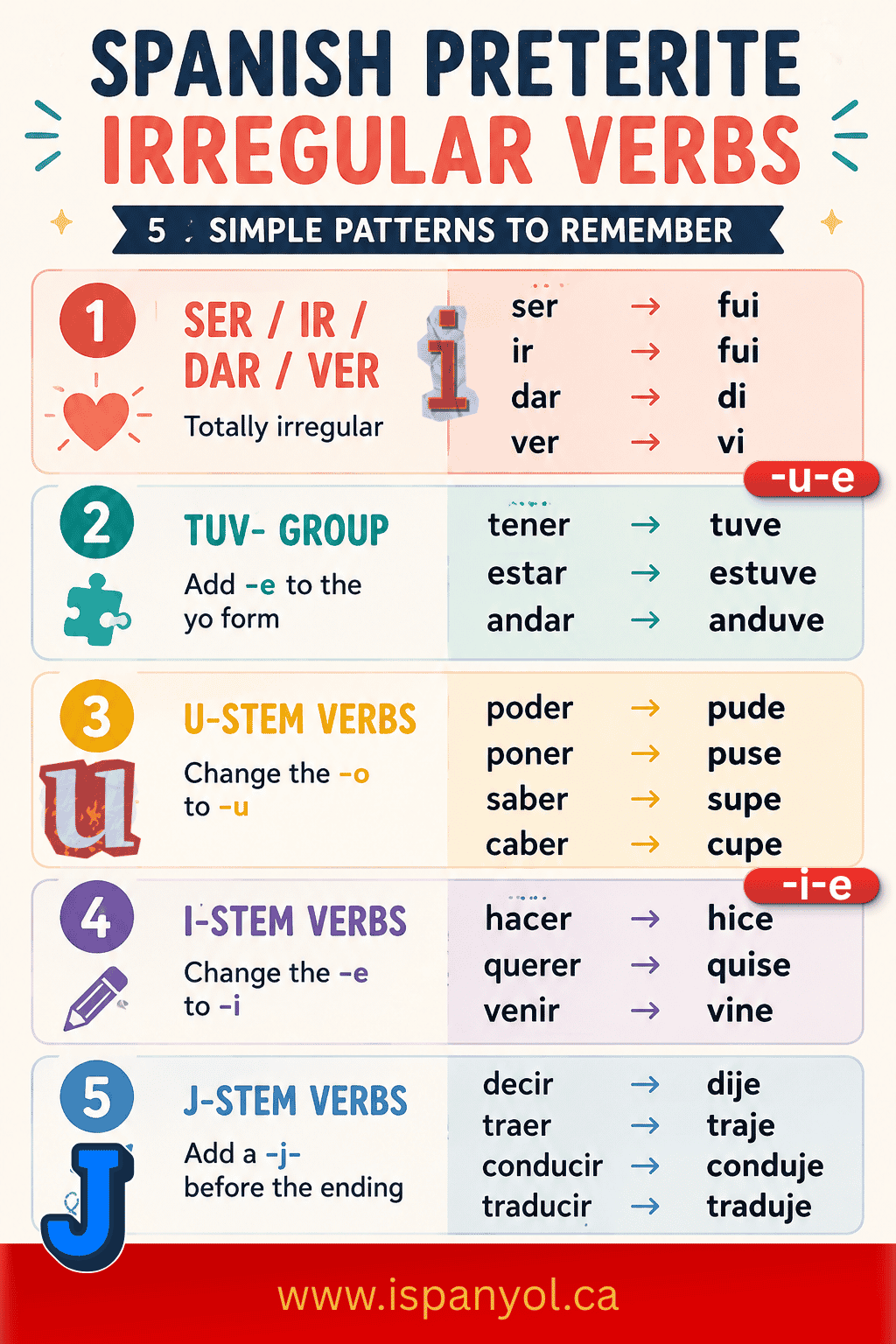
Spanish Irregular Preterite Verbs

Learn the most important irregular verbs in the Spanish preterite tense (pretérito indefinido): forms like fui, tuve, hice, dije, pude, puse, supe, traje, conduje and cupo.

Usage / Uso

Use the preterite for completed actions in a finished past timeframe.

Common triggers: ayer (yesterday), anoche (last night), la semana pasada (last week), hace dos horas (two hours ago).

For a broader overview of irregular patterns across tenses, see the Spanish irregular verbs guide.

Key Irregular Verbs

Ser / Ir was / went
fui, fuiste, fue, fuimos, fuisteis, fueron

Fui a Madrid. I went to Madrid.

Tener had
tuve, tuviste, tuvo, tuvimos, tuvisteis, tuvieron

Tuve una idea. I had an idea.

Estar was / were
estuve, estuviste, estuvo, estuvimos, estuvisteis, estuvieron

Estuve en casa. I was at home.

Hacer did / made
hice, hiciste, hizo, hicimos, hicisteis, hicieron

Hice la tarea. I did the homework.

Decir said / told
dije, dijiste, dijo, dijimos, dijisteis, dijeron

Dije la verdad. I told the truth.

Poder managed / could
pude, pudiste, pudo, pudimos, pudisteis, pudieron

Pude terminar. I managed to finish.

Poner put / became
puse, pusiste, puso, pusimos, pusisteis, pusieron

Puse la mesa. I set the table.

Venir came
vine, viniste, vino, vinimos, vinisteis, vinieron

Vine temprano. I came early.

Querer wanted / tried
quise, quisiste, quiso, quisimos, quisisteis, quisieron

Quise ayudar. I wanted/tried to help.

Saber found out
supe, supiste, supo, supimos, supisteis, supieron

Supe la respuesta. I found out the answer.

Dar / Ver gave / saw
di, diste, dio... / vi, viste, vio...

Le di una oportunidad. Vi la película. I gave him/her a chance. I saw the movie.

-ducir verbs drove / translated
conduje, condujiste, condujo, condujimos, condujisteis, condujeron

Conduje cinco horas. I drove for five hours.

Traer brought
traje, trajiste, trajo, trajimos, trajisteis, trajeron

Traje los documentos. I brought the documents.

Andar walked / went around
anduve, anduviste, anduvo, anduvimos, anduvisteis, anduvieron

Anduve por el centro. I walked around downtown.

Caber fit
cupe, cupiste, cupo, cupimos, cupisteis, cupieron

No cupo en la caja. It didn’t fit in the box.

Pattern Cheat Sheet

super-short forms ser / ir → fui, dar → di, ver → vi
tuv- / estuv- / anduv- group tener → tuve, estar → estuve, andar → anduve
u-stem group poder → pude, poner → puse, saber → supe, caber → cupe
i-stem group hacer → hice, querer → quise, venir → vine
j-stem group decir → dije, traer → traje, conducir → conduje, traducir → traduje
no regular preterite accents These irregular preterite forms do not carry the regular preterite accents: tuve, not tuvé.

Important Notes

  • Ser and ir share the exact same preterite forms: fui, fuiste, fue.... Context tells you the meaning.
  • Hacer changes spelling in the third person singular: hizo, not hico.
  • J-stem verbs drop the regular i in third person plural: dijeron, trajeron, condujeron.
  • Saber in the preterite often means “found out”; poder often means “managed to”; no poder means “couldn’t / failed to”.
  • Querer can mean “wanted” or “tried”; no quiso often means “refused”.

Quick Reference

Memorize these high-frequency forms first:

fui, tuve, estuve, anduve, hice, dije, pude, puse, vine, quise, supe, cupo, traje, vi, di

Top 20 Daily Expressions

1
Ser / Ir → fui Fui al médico porque me sentía mal. I went to the doctor because I was feeling unwell.
2
Ser / Ir → fue La reunión fue mucho más larga de lo esperado. The meeting was much longer than expected.
3
Tener → tuve Tuve la oportunidad de hablar con ella. I had the opportunity to speak with her.
4
Tener → tuvieron Tuvieron problemas para encontrar el lugar. They had trouble finding the place.
5
Estar → estuve Estuve trabajando todo el fin de semana. I was working all weekend.
6
Estar → estuvo Estuvo muy amable conmigo. He/She was very kind to me.
7
Poder → pude No pude terminar el proyecto a tiempo. I couldn't finish the project on time.
8
Poder → pudieron Por fin pudieron resolver el problema. They finally managed to solve the problem.
9
Poner → puse Puse mucha atención durante la clase. I paid close attention during class.
10
Poner → se puso Se puso nervioso antes del examen. He got nervous before the exam.
11
Hacer → hice Hice todo lo posible para ayudar. I did everything possible to help.
12
Hacer → hizo La noticia hizo que cambiara de opinión. The news made me change my mind.
13
Decir → dije Le dije la verdad desde el principio. I told him/her the truth from the beginning.
14
Decir → dijeron Me dijeron que llegara temprano. They told me to arrive early.
15
Venir → vine Vine porque quería hablar contigo. I came because I wanted to talk to you.
16
Querer → quise Quise ayudarte, pero no pude. I wanted to help you, but I couldn’t.
17
Saber → supe Supe la noticia ayer por la tarde. I found out the news yesterday afternoon.
18
Traer → traje Traje los documentos que me pediste. I brought the documents you asked me for.
19
Conducir → conduje Conduje durante cinco horas seguidas. I drove for five hours straight.
20
Dar → di Le di una segunda oportunidad. I gave him/her a second chance.