A2 Priority List
A2 Priority Preterite Irregulars
Top 10 forms to learn first
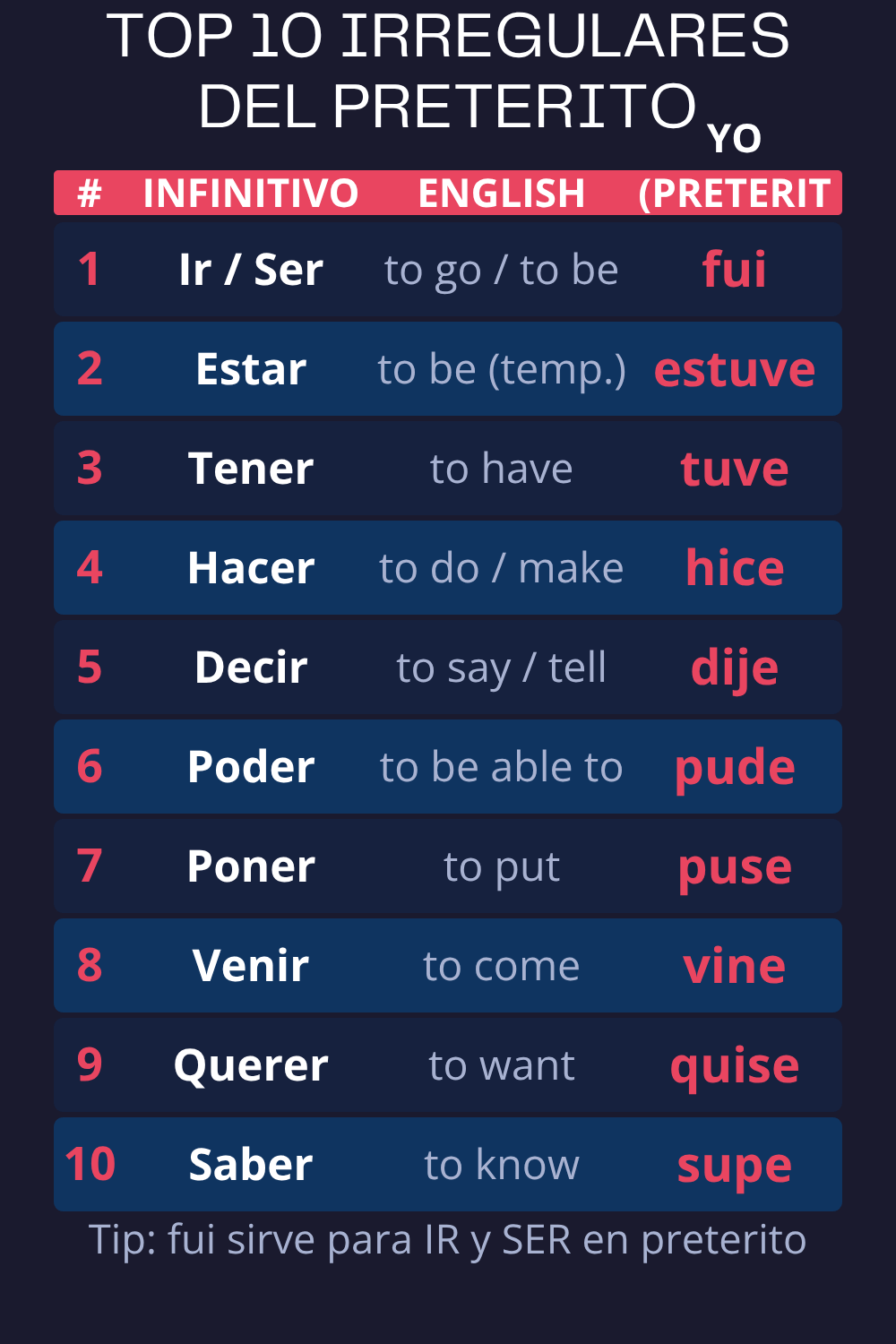
Start with 10 high-priority irregular preterite forms before moving to the full system. This page is a compact yo-form priority list, not a complete conjugation guide. For full paradigms, shared endings, more irregular stems and third-person changes, see the Spanish irregular preterite guide. For a broader view across tenses, use the Irregular Verbs pattern guide, or compare six key forms in the Top 40 Irregular Verbs reference.
Top 10 priority yo forms
| Verb | Yo preterite | Meaning | Daily example |
|---|---|---|---|
| ser / ir | fui | I was / I went | Fui al centro. I went downtown. |
| estar | estuve | I was | Estuve ocupado. I was busy. |
| tener | tuve | I had | Tuve una idea. I had an idea. |
| hacer | hice | I did / made | Hice lo posible. I did my best. |
| decir | dije | I said / told | Le dije la verdad. I told him/her the truth. |
| poder | pude | I managed to / I could | No pude venir. I couldn't come. |
| poner | puse | I put / set | Puse la mesa. I set the table. |
| venir | vine | I came | Vine temprano. I came early. |
| querer | quise | I wanted / tried | Quise ayudarte. I wanted to help you. |
| saber | supe | I found out | Supe la noticia ayer. I found out the news yesterday. |
Learn them by pattern
Twin form
ser / ir → fui
The same form can mean “I was” or “I went.” Context decides.
U-stem forms
estuve, tuve, pude, puse, supe
These are the most useful u-stem forms to memorize first.
I-stem forms
hice, quise, vine
Hacer has a spelling change: hizo, not hico.
J-stem preview
dije
More j-stem verbs: traje, conduje, traduje.
Common preterite readings to recognize
pude can imply “I managed to” in a completed-event context. No pude normally means “I couldn’t / I was unable to.”
supe often has the reading “I found out / learned” when it refers to a completed discovery.
quise can mean “I wanted” and, in some contexts, “I tried.”
no quiso can mean “he/she did not want to” and often carries the sense “refused.”
Two tiny forms to learn next
dar → di
Le di una oportunidad. I gave him/her a chance.
ver → vi
Vi la película. I saw the movie.