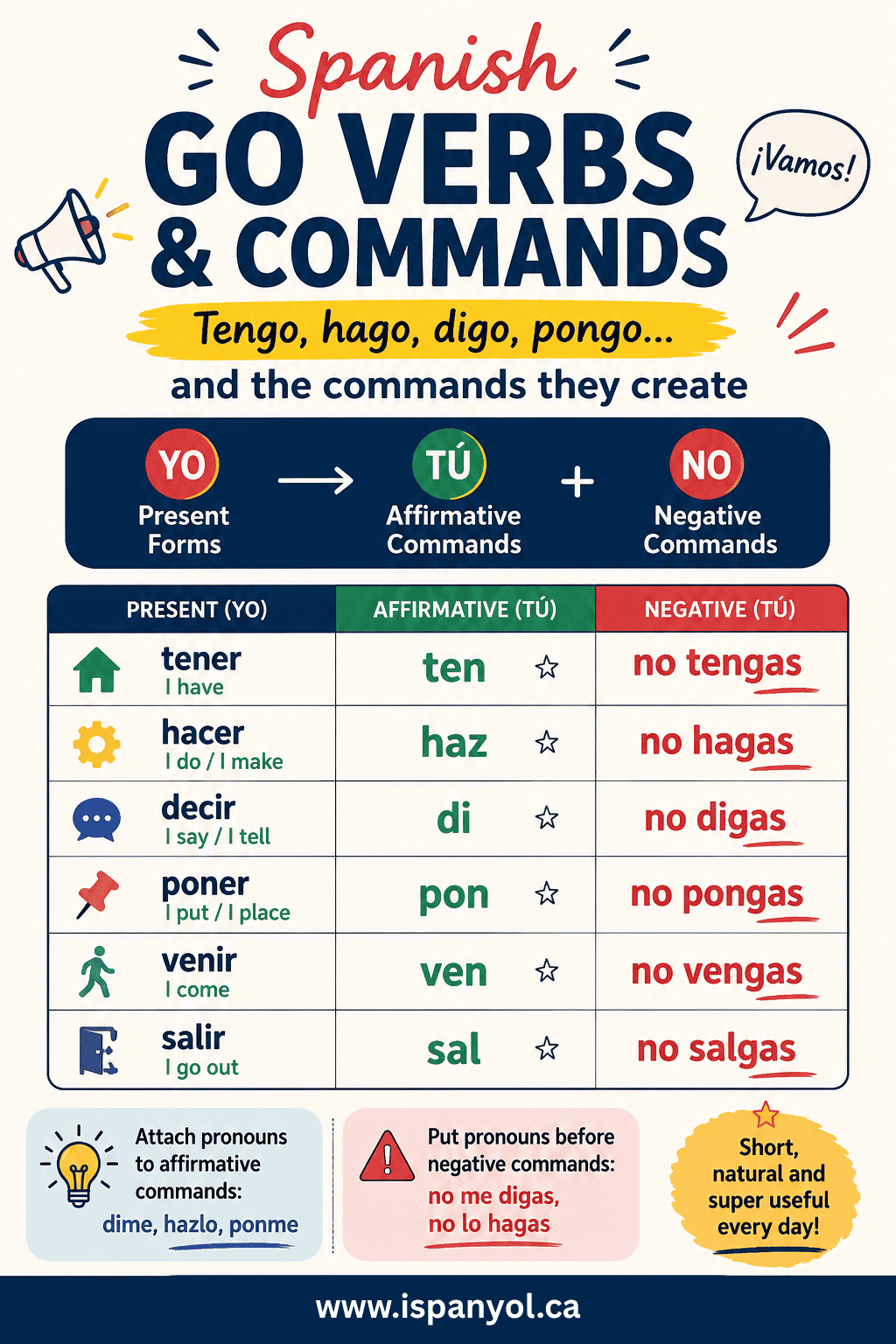
This page — Yo-go pattern
tengo, hago, digo, pongo, vengo, salgo and their connection to ten / no tengas, haz / no hagas, di / no digas.
Yo-go pattern + tú commands
Learn six high-frequency Spanish yo-go verbs — tengo, hago, digo, pongo, vengo, salgo — and see how they connect to two command patterns: irregular affirmative tú forms such as ten, haz, di, and negative commands such as no tengas, no hagas, no digas.
If you arrived here from another command page, use this quick map.
This page — Yo-go pattern
tengo, hago, digo, pongo, vengo, salgo and their connection to ten / no tengas, haz / no hagas, di / no digas.
Imperatives — Grammar & Formation
Use this for the complete command system: affirmative and negative forms, persons, pronouns and formation rules.
Everyday Commands & Fixed Expressions
Use this for conversational chunks such as dime, venga, pasa, déjame pensar and other commands heard in real speech.
1. Present yo-go form
The six core verbs have a present yo form ending in -go: tengo, hago, digo, pongo, vengo, salgo.
2. Affirmative tú: learn the chunk
ten, haz, di, pon, ven, sal are irregular affirmative tú forms. Do not try to mechanically build them from tengo, hago, digo...
3. Negative tú: the real yo connection
The irregular yo stem leads into the present subjunctive: tengo → tenga → no tengas, hago → haga → no hagas.
Why the yo form matters
For these verbs, take the irregular present yo form, remove the final -o, and use that stem for the present subjunctive. The negative tú command then uses the tú subjunctive form.
pongo → ponga → no pongas · vengo → venga → no vengas
The six target verbs share a present yo form ending in -go. Their affirmative tú commands are irregular forms to learn as chunks; their negative commands connect directly to the present subjunctive.
| Infinitive | Present yo | Affirmative tú | Negative tú | Daily example |
|---|---|---|---|---|
| tener to have | tengo | ten | no tengas | Ten cuidado. Be careful. |
| hacer to do / make | hago | haz | no hagas | Hazlo ahora. Do it now. |
| decir to say / tell | digo | di | no digas | Dime la verdad. Tell me the truth. |
| poner to put / place | pongo | pon | no pongas | Ponlo aquí. Put it here. |
| venir to come | vengo | ven | no vengas | Ven aquí. Come here. |
| salir to leave / go out | salgo | sal | no salgas | Sal de aquí. Get out of here. |
Ir and ser belong to the classic eight-command mnemonic, but they are not yo-go verbs. Learn their command forms separately.
The broader -go family also includes forms such as traigo, caigo, oigo and valgo. Other yo irregulars, such as conozco, follow a different spelling pattern. In both cases, the affirmative tú command may still follow the normal él/ella present form, while the negative command uses the subjunctive.
| Infinitive | Present yo | Affirmative tú | Negative tú |
|---|---|---|---|
| traer to bring | traigo | trae | no traigas |
| caer to fall | caigo | cae | no caigas |
| oír to hear | oigo | oye | no oigas |
| valer to be worth | valgo | vale | no valgas |
| conocer to know / meet | conozco | conoce | no conozcas |
With positive commands, pronouns attach to the end of the command. For the complete placement and accent rules, use the Imperatives Grammar Guide.
Dime. Tell me.
Hazlo ahora. Do it now.
Ponte cómodo. Make yourself comfortable.
With negative commands, pronouns come before the verb.
No me digas. Don’t tell me. / Really?
No lo hagas. Don’t do it.
No te pongas nervioso. Don’t get nervous.
These examples reinforce the six target verbs. For a broader collection of conversational command chunks, use the Everyday Commands & Fixed Expressions guide.
Learn these as whole phrases. This is a recap of the target verbs, not a complete list of everyday Spanish commands.